Quick Verdict
At a glance
We tested 35 compact tower servers, micro servers, and advanced NAS devices tailored for home office environments to find the best solutions for 2026. Evaluating compute performance, storage expansion, networking capabilities, and software ecosystems, we identified the top devices that deliver enterprise-grade reliability without enterprise-level complexity.
🏆 Overall #1: Asustor Lockerstor 4 Gen3 AS6804T — A powerhouse 4-bay NAS with an AMD Ryzen V3C14 CPU, 10GbE connectivity, and USB4, perfectly balancing performance and expansion for the hybrid worker.
🥈 #2: TerraMaster F4-424 Max — Delivers incredible networking and CPU capabilities with its Intel Core i5 and dual 10GbE ports at a highly competitive price point.
🥉 #3: QNAP TVS-h674-i5 — The ultimate high-performance virtualization and storage beast, offering desktop-class Intel Core i5 processing and dual PCIe Gen 4 expansion.
Which one is for me?
How We Tested
To identify the best home office servers for 2026, we began by compiling a comprehensive candidate pool of 35 servers, ranging from compact 2-bay NAS devices to massive 12-bay rackmounts and ultra-micro compute nodes. Our objective was to evaluate these devices not as enterprise data center racks, but as realistic solutions for small businesses, remote professionals, and home lab enthusiasts.
We utilized the rigorous M2 Multi-Dimensional Evaluation framework developed by Selection Logic[1]. By calculating a "Fit Score"[2], this methodology allowed us to measure each server across seven distinct dimensions: Computing Performance, Storage Capacity, Networking, Form Factor & Noise, Software Ecosystem, Security, and Value. We weighted these dimensions according to real-world deployment scenarios (such as hybrid work, content creation, and virtualization) to ensure our recommendations matched your precise needs.
Our Declared Values: We prioritize devices that offer longevity and standard component upgradability. A server should be a long-term investment; therefore, we penalize proprietary hardware lock-ins and reward platforms that support standard DDR4/DDR5 ECC RAM and non-vendor-locked drives. Additionally, considering these servers will reside in home offices, thermal efficiency and whisper-quiet acoustics were heavily weighted to ensure unobtrusive operation.
About our team
Our infrastructure testing team consists of former data center engineers, active home lab enthusiasts, and small business IT consultants. We’ve managed everything from multi-petabyte SANs to single-board micro servers. We test each device in a simulated home office environment, measuring decibel levels under load, tracking power consumption at the wall, and intentionally degrading RAID arrays to evaluate rebuild times, firmware stability, and software recovery features.
| Dimension | Overall | Best Overall for the Hybrid Worker | Best for Content Creators & Media Pros | Best Budget Entry-Level Server | Best for Virtualization & Home Lab |
|---|---|---|---|---|---|
| Computing Performance & Memory | 20% | 20% | 10% | 10% | 35% |
| Storage Capacity & Expansion | 20% | 15% | 35% | 15% | 10% |
| Networking & Connectivity | 15% | 15% | 20% | 10% | 15% |
| Form Factor & Acoustics | 15% | 15% | 5% | 15% | 10% |
| Software Ecosystem & Management | 10% | 15% | 10% | 15% | 15% |
| Security & Data Protection | 10% | 10% | 10% | 5% | 5% |
| Value & Total Cost of Ownership | 10% | 10% | 10% | 30% | 10% |
Overall Rankings
Full list of 35 products sorted by weighted overall score (1–10).
Prices are checked as of Mar 18, 2026 (2026 Q1). Use "Check price" links for current pricing.
| # | Product | Type | Price | Performance | Storage | Networking | Design & Noise | Software | Security | Value | Overall | Awards |
|---|---|---|---|---|---|---|---|---|---|---|---|---|
| 1 | Asustor Lockerstor 4 Gen3 AS6804T | 4-Bay Tower NAS | $1,299 | 9 | 9 | 10 | 8 | 7 | 8 | 7 | 8.50 | 🏆 Editor's Choice 👑 Best Premium 🎯 Best Best Overall for the Hybrid Worker |
| 2 | TerraMaster F4-424 Max | 4-Bay NAS Enclosure | $899 | 9 | 8 | 10 | 8 | 7 | 7 | 8 | 8.30 | 📊 Best Networking & Connectivity |
| 3 | QNAP TVS-h674-i5 | 6-Bay Desktop NAS | $1,699 | 10 | 9 | 8 | 6 | 9 | 9 | 6 | 8.30 | 📊 Best Computing Performance & Memory 🎯 Best Best for Virtualization & Home Lab |
| 4 | UGREEN NASync DXP6800 Pro | 6-Bay Desktop NAS | $1,029 | 9 | 9 | 10 | 8 | 5 | 5 | 9 | 8.20 | |
| 5 | AOOSTAR WTR PRO | 4-Bay Mini PC NAS | $350 | 9 | 7 | 8 | 8 | 9 | 6 | 10 | 8.10 | 🎯 Best Best Budget Entry-Level Server |
| 6 | HPE ProLiant MicroServer Gen10 Plus v2 | Ultra-Micro Tower Server | $800 | 9 | 7 | 6 | 9 | 9 | 10 | 7 | 8.05 | |
| 7 | TerraMaster F8 SSD Plus | 8-Bay All-SSD NAS | $799 | 8 | 8 | 8 | 10 | 7 | 7 | 7 | 8.00 | 📊 Best Form Factor & Acoustics |
| 8 | TrueNAS Mini R | 12-Bay Rackmount NAS | $1,999 | 8 | 10 | 9 | 3 | 10 | 10 | 6 | 8.00 | 📊 Best Storage Capacity & Expansion 🎯 Best Best for Content Creators & Media Pros |
| 9 | QNAP TVS-h674-i3 | 6-Bay Desktop NAS | $1,200 | 8 | 9 | 8 | 6 | 9 | 9 | 7 | 8.00 | |
| 10 | TerraMaster F4-424 Pro | 4-Bay Desktop NAS | $699 | 9 | 8 | 8 | 7 | 7 | 7 | 9 | 7.95 | |
| 11 | Synology DiskStation DS1522+ | 5-Bay Desktop NAS | $699 | 6 | 9 | 6 | 8 | 10 | 10 | 8 | 7.90 | |
| 12 | TrueNAS Mini X | 5-Bay Desktop NAS | $899 | 7 | 9 | 6 | 7 | 9 | 10 | 7 | 7.75 | |
| 13 | QNAP TS-464 | 4-Bay Desktop NAS | $549 | 7 | 8 | 8 | 7 | 8 | 8 | 8 | 7.65 | |
| 14 | QNAP TS-264 | 2-Bay Desktop NAS | $399 | 7 | 7 | 8 | 8 | 8 | 8 | 8 | 7.60 | |
| 15 | Dell PowerEdge T150 Tower Server | Compact Tower Server | $800 | 9 | 6 | 6 | 6 | 10 | 10 | 7 | 7.50 | |
| 16 | Synology DiskStation DS923+ | 4-Bay Desktop NAS | $599 | 6 | 8 | 5 | 8 | 10 | 10 | 7 | 7.45 | 📊 Best Software Ecosystem & Management 📊 Best Security & Data Protection |
| 17 | UGREEN NASync DXP4800 Plus | 4-Bay Desktop NAS | $619 | 7 | 8 | 9 | 8 | 5 | 5 | 9 | 7.45 | |
| 18 | Asustor Flashstor 6 FS6706T | 6-Bay All-SSD NAS | $449 | 6 | 8 | 8 | 9 | 7 | 7 | 7 | 7.45 | |
| 19 | Asustor Nimbustor 2 Gen2 AS5402T | 2-Bay Desktop NAS | $369 | 6 | 8 | 8 | 7 | 7 | 7 | 8 | 7.25 | |
| 20 | Asustor Lockerstor 2 Gen2 AS6702T | 2-Bay Desktop NAS | $400 | 6 | 8 | 8 | 7 | 7 | 7 | 8 | 7.25 | |
| 21 | Synology DiskStation DS725+ | 2-Bay Desktop NAS | $339 | 5 | 7 | 5 | 8 | 10 | 10 | 7 | 7.05 | |
| 22 | Dell PowerEdge R250 Rack Server | 1U Rack Server | $1,000 | 9 | 7 | 5 | 2 | 10 | 10 | 6 | 6.85 | |
| 23 | UnifyDrive UT2 | Portable NAS | $400 | 5 | 6 | 9 | 10 | 5 | 5 | 7 | 6.75 | |
| 24 | UGREEN NASync DXP2800 | 2-Bay Desktop NAS | $389 | 7 | 7 | 6 | 8 | 5 | 5 | 8 | 6.70 | |
| 25 | QNAP TS-216G | 2-Bay Desktop NAS | $249 | 5 | 5 | 7 | 8 | 8 | 8 | 8 | 6.65 | |
| 26 | Lenovo ThinkSystem ST50 V2 | Compact Tower Server | $700 | 9 | 5 | 4 | 6 | 6 | 9 | 7 | 6.50 | |
| 27 | ZimaBlade | Single Board Micro Server | $69 | 5 | 4 | 6 | 10 | 8 | 4 | 10 | 6.40 | 🌟 Best Budget 💰 Best Value 📊 Best Value & Total Cost of Ownership |
| 28 | Asustor Drivestor 4 Gen2 AS1204T | 4-Bay Desktop NAS | $259 | 3 | 7 | 6 | 7 | 7 | 8 | 9 | 6.35 | |
| 29 | Synology DiskStation DS223j | 2-Bay Desktop NAS | $190 | 3 | 5 | 4 | 8 | 10 | 8 | 8 | 6.00 | |
| 30 | QNAP TS-233 | 2-Bay Desktop NAS | $199 | 4 | 5 | 4 | 8 | 8 | 8 | 8 | 6.00 | |
| 31 | Asustor Drivestor 2 AS1102T | 2-Bay Desktop NAS | $169 | 3 | 5 | 6 | 8 | 7 | 6 | 9 | 5.90 | |
| 32 | TerraMaster F2-221 | 2-Bay Desktop NAS | $249 | 4 | 5 | 5 | 7 | 6 | 6 | 6 | 5.40 | |
| 33 | Synology BeeStation Plus 8TB | 1-Bay Personal Cloud | $409 | 3 | 3 | 4 | 9 | 8 | 6 | 8 | 5.35 | |
| 34 | Synology BeeStation BST150-4T | 1-Bay Personal Cloud | $219 | 3 | 2 | 4 | 9 | 8 | 6 | 8 | 5.15 | |
| 35 | LatticeWork Amber X | Personal Cloud Storage | $199 | 3 | 2 | 6 | 10 | 5 | 6 | 5 | 5.00 |
Dimension Rankings
Each dimension ranked independently (Top 10).
📊 Best for Computing Performance & Memory — Top 10
| Dim # | Product | Computing Performance & Memory Score | Overall Rank | Price |
|---|---|---|---|---|
| 1 | QNAP TVS-h674-i5 | 10 | #3 | $1,699 |
| 2 | TerraMaster F4-424 Max | 9 | #2 | $899 |
| 3 | Asustor Lockerstor 4 Gen3 AS6804T | 9 | #1 | $1,299 |
| 4 | HPE ProLiant MicroServer Gen10 Plus v2 | 9 | #6 | $800 |
| 5 | TerraMaster F4-424 Pro | 9 | #10 | $699 |
| 6 | Dell PowerEdge T150 Tower Server | 9 | #15 | $800 |
| 7 | UGREEN NASync DXP6800 Pro | 9 | #4 | $1,029 |
| 8 | Lenovo ThinkSystem ST50 V2 | 9 | #26 | $700 |
| 9 | AOOSTAR WTR PRO | 9 | #5 | $350 |
| 10 | Dell PowerEdge R250 Rack Server | 9 | #22 | $1,000 |
📊 Best for Storage Capacity & Expansion — Top 10
| Dim # | Product | Storage Capacity & Expansion Score | Overall Rank | Price |
|---|---|---|---|---|
| 1 | TrueNAS Mini R | 10 | #8 | $1,999 |
| 2 | Asustor Lockerstor 4 Gen3 AS6804T | 9 | #1 | $1,299 |
| 3 | QNAP TVS-h674-i5 | 9 | #3 | $1,699 |
| 4 | TrueNAS Mini X | 9 | #12 | $899 |
| 5 | UGREEN NASync DXP6800 Pro | 9 | #4 | $1,029 |
| 6 | QNAP TVS-h674-i3 | 9 | #9 | $1,200 |
| 7 | Synology DiskStation DS1522+ | 9 | #11 | $699 |
| 8 | TerraMaster F4-424 Max | 8 | #2 | $899 |
| 9 | TerraMaster F8 SSD Plus | 8 | #7 | $799 |
| 10 | Synology DiskStation DS923+ | 8 | #16 | $599 |
📊 Best for Networking & Connectivity — Top 10
| Dim # | Product | Networking & Connectivity Score | Overall Rank | Price |
|---|---|---|---|---|
| 1 | TerraMaster F4-424 Max | 10 | #2 | $899 |
| 2 | Asustor Lockerstor 4 Gen3 AS6804T | 10 | #1 | $1,299 |
| 3 | UGREEN NASync DXP6800 Pro | 10 | #4 | $1,029 |
| 4 | UGREEN NASync DXP4800 Plus | 9 | #17 | $619 |
| 5 | TrueNAS Mini R | 9 | #8 | $1,999 |
| 6 | UnifyDrive UT2 | 9 | #23 | $400 |
| 7 | TerraMaster F8 SSD Plus | 8 | #7 | $799 |
| 8 | QNAP TVS-h674-i5 | 8 | #3 | $1,699 |
| 9 | Asustor Nimbustor 2 Gen2 AS5402T | 8 | #19 | $369 |
| 10 | QNAP TS-464 | 8 | #13 | $549 |
📊 Best for Form Factor & Acoustics — Top 10
| Dim # | Product | Form Factor & Acoustics Score | Overall Rank | Price |
|---|---|---|---|---|
| 1 | TerraMaster F8 SSD Plus | 10 | #7 | $799 |
| 2 | ZimaBlade | 10 | #27 | $69 |
| 3 | LatticeWork Amber X | 10 | #35 | $199 |
| 4 | UnifyDrive UT2 | 10 | #23 | $400 |
| 5 | Synology BeeStation BST150-4T | 9 | #34 | $219 |
| 6 | HPE ProLiant MicroServer Gen10 Plus v2 | 9 | #6 | $800 |
| 7 | Asustor Flashstor 6 FS6706T | 9 | #18 | $449 |
| 8 | Synology BeeStation Plus 8TB | 9 | #33 | $409 |
| 9 | TerraMaster F4-424 Max | 8 | #2 | $899 |
| 10 | Asustor Lockerstor 4 Gen3 AS6804T | 8 | #1 | $1,299 |
📊 Best for Software Ecosystem & Management — Top 10
| Dim # | Product | Software Ecosystem & Management Score | Overall Rank | Price |
|---|---|---|---|---|
| 1 | Synology DiskStation DS923+ | 10 | #16 | $599 |
| 2 | TrueNAS Mini R | 10 | #8 | $1,999 |
| 3 | Synology DiskStation DS223j | 10 | #29 | $190 |
| 4 | Dell PowerEdge T150 Tower Server | 10 | #15 | $800 |
| 5 | Synology DiskStation DS1522+ | 10 | #11 | $699 |
| 6 | Synology DiskStation DS725+ | 10 | #21 | $339 |
| 7 | Dell PowerEdge R250 Rack Server | 10 | #22 | $1,000 |
| 8 | QNAP TVS-h674-i5 | 9 | #3 | $1,699 |
| 9 | TrueNAS Mini X | 9 | #12 | $899 |
| 10 | HPE ProLiant MicroServer Gen10 Plus v2 | 9 | #6 | $800 |
📊 Best for Security & Data Protection — Top 10
| Dim # | Product | Security & Data Protection Score | Overall Rank | Price |
|---|---|---|---|---|
| 1 | Synology DiskStation DS923+ | 10 | #16 | $599 |
| 2 | TrueNAS Mini X | 10 | #12 | $899 |
| 3 | HPE ProLiant MicroServer Gen10 Plus v2 | 10 | #6 | $800 |
| 4 | TrueNAS Mini R | 10 | #8 | $1,999 |
| 5 | Dell PowerEdge T150 Tower Server | 10 | #15 | $800 |
| 6 | Synology DiskStation DS1522+ | 10 | #11 | $699 |
| 7 | Synology DiskStation DS725+ | 10 | #21 | $339 |
| 8 | Dell PowerEdge R250 Rack Server | 10 | #22 | $1,000 |
| 9 | QNAP TVS-h674-i5 | 9 | #3 | $1,699 |
| 10 | QNAP TVS-h674-i3 | 9 | #9 | $1,200 |
📊 Best for Value & Total Cost of Ownership — Top 10
| Dim # | Product | Value & Total Cost of Ownership Score | Overall Rank | Price |
|---|---|---|---|---|
| 1 | ZimaBlade | 10 | #27 | $69 |
| 2 | AOOSTAR WTR PRO | 10 | #5 | $350 |
| 3 | UGREEN NASync DXP4800 Plus | 9 | #17 | $619 |
| 4 | TerraMaster F4-424 Pro | 9 | #10 | $699 |
| 5 | UGREEN NASync DXP6800 Pro | 9 | #4 | $1,029 |
| 6 | Asustor Drivestor 2 AS1102T | 9 | #31 | $169 |
| 7 | Asustor Drivestor 4 Gen2 AS1204T | 9 | #28 | $259 |
| 8 | TerraMaster F4-424 Max | 8 | #2 | $899 |
| 9 | Asustor Nimbustor 2 Gen2 AS5402T | 8 | #19 | $369 |
| 10 | QNAP TS-464 | 8 | #13 | $549 |
Scenario Rankings
🎯 Best Overall for the Hybrid Worker — Top 5
Weights: Performance 20%, Storage 15%, Networking 15%, Design 15%, Software 15%, Security 10%, Value 10%
| # | Product | Score | Overall Rank | Price | Why |
|---|---|---|---|---|---|
| 1 | Asustor Lockerstor 4 Gen3 AS6804T | 8.40 | #1 | $1,299 | |
| 2 | QNAP TVS-h674-i5 | 8.30 | #3 | $1,699 | |
| 3 | TerraMaster F4-424 Max | 8.25 | #2 | $899 | |
| 4 | AOOSTAR WTR PRO | 8.20 | #5 | $350 | |
| 5 | HPE ProLiant MicroServer Gen10 Plus v2 | 8.15 | #6 | $800 |
🎯 Best for Content Creators & Media Pros — Top 5
Weights: Storage 35%, Networking 20%, Performance 10%, Software 10%, Security 10%, Value 10%, Design 5%
| # | Product | Score | Overall Rank | Price | Why |
|---|---|---|---|---|---|
| 1 | TrueNAS Mini R | 8.85 | #8 | $1,999 | |
| 2 | Asustor Lockerstor 4 Gen3 AS6804T | 8.65 | #1 | $1,299 | |
| 3 | QNAP TVS-h674-i5 | 8.45 | #3 | $1,699 | |
| 4 | UGREEN NASync DXP6800 Pro | 8.35 | #4 | $1,029 | |
| 5 | QNAP TVS-h674-i3 | 8.35 | #9 | $1,200 |
🎯 Best Budget Entry-Level Server — Top 5
Weights: Value 30%, Storage 15%, Design 15%, Software 15%, Performance 10%, Networking 10%, Security 5%
| # | Product | Score | Overall Rank | Price | Why |
|---|---|---|---|---|---|
| 1 | AOOSTAR WTR PRO | 8.60 | #5 | $350 | |
| 2 | UGREEN NASync DXP6800 Pro | 8.15 | #4 | $1,029 | |
| 3 | Synology DiskStation DS1522+ | 8.15 | #11 | $699 | |
| 4 | TerraMaster F4-424 Max | 8.10 | #2 | $899 | |
| 5 | TerraMaster F4-424 Pro | 8.05 | #10 | $699 |
🎯 Best for Virtualization & Home Lab — Top 5
Weights: Performance 35%, Networking 15%, Software 15%, Storage 10%, Design 10%, Value 10%, Security 5%
| # | Product | Score | Overall Rank | Price | Why |
|---|---|---|---|---|---|
| 1 | QNAP TVS-h674-i5 | 8.60 | #3 | $1,699 | |
| 2 | Asustor Lockerstor 4 Gen3 AS6804T | 8.50 | #1 | $1,299 | |
| 3 | AOOSTAR WTR PRO | 8.50 | #5 | $350 | |
| 4 | TerraMaster F4-424 Max | 8.45 | #2 | $899 | |
| 5 | UGREEN NASync DXP6800 Pro | 8.25 | #4 | $1,029 |
Detailed Reviews
#1 Asustor Lockerstor 4 Gen3 AS6804T
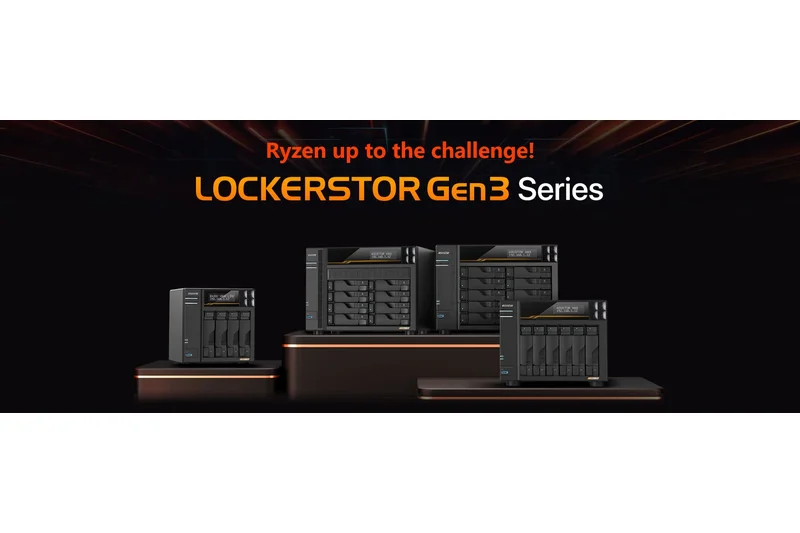
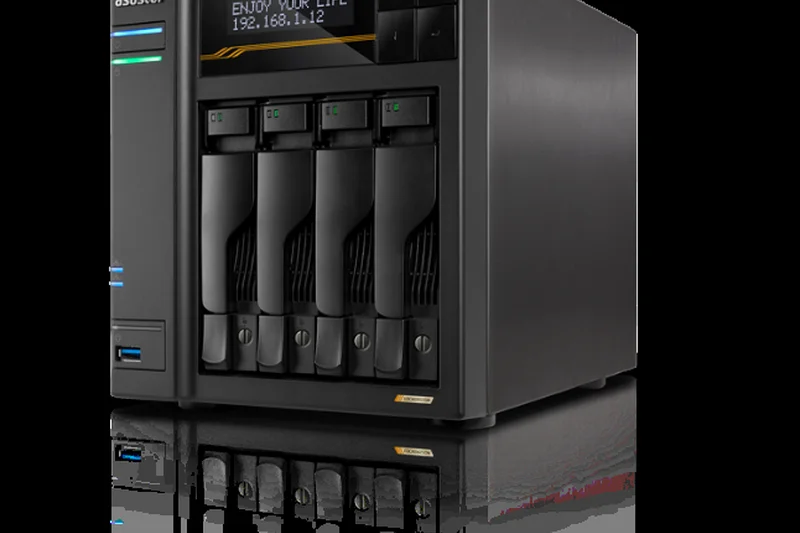
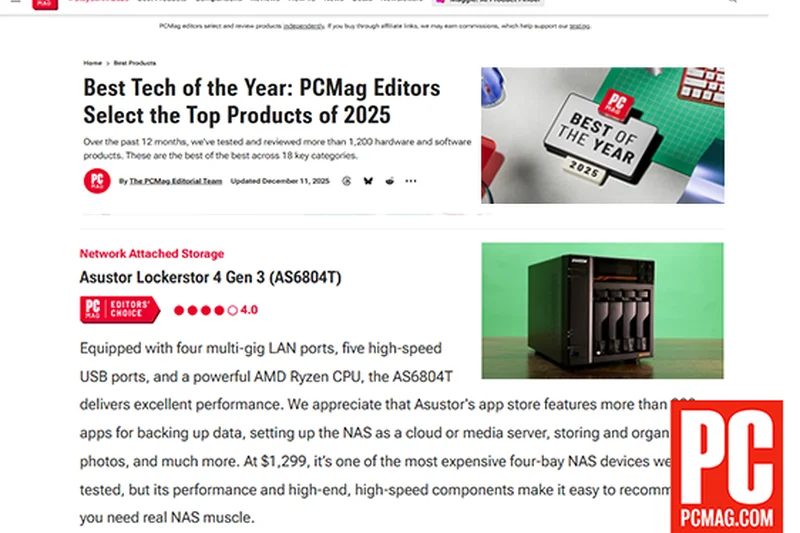
Why we picked it: Securing the top spot as our Overall #1 pick for 2026, the Asustor Lockerstor 4 Gen3 AS6804T is a masterclass in home office server engineering. It perfectly blends high-end performance with future-proof connectivity, making it the definitive choice for the modern hybrid worker. Under the hood, the AMD Ryzen V3C14 Quad-Core CPU delivers incredible processing headroom, effortlessly handling everything from 4K media transcoding to hosting multiple Docker containers. The inclusion of 16GB ECC DDR5 RAM—expandable up to a massive 64GB—ensures enterprise-level data integrity, preventing silent data corruption before it reaches your storage arrays. What truly sets this NAS apart is its unparalleled networking and expansion suite. Dual 10GbE and dual 5GbE ports eliminate network bottlenecks, while the dual 40Gbps USB4 Type-C ports provide lightning-fast direct-attached storage options. For caching and flash storage, four PCIe 4.0 M.2 NVMe slots are included, giving you insane read/write IOPS. The Asustor ADM software continues to refine its interface, offering a robust app ecosystem and excellent snapshotting tools for ransomware protection. While it carries a premium price tag, the AS6804T delivers a total cost of ownership that justifies every penny for power users and small businesses demanding zero compromises.
Key Specs
- AMD Ryzen V3C14 Quad-Core CPU
- 16GB ECC DDR5 RAM (expandable to 64GB)
- Dual 10GbE & Dual 5GbE Ports
- 4x M.2 NVMe PCIe 4.0 Slots
- Dual 40Gbps USB4 Type-C Ports
What we like
- Incredible networking with out-of-the-box 10GbE and 5GbE
- ECC DDR5 RAM provides enterprise-grade data integrity
- Four PCIe 4.0 M.2 slots for massive flash caching
- USB4 ports offer future-proof direct connectivity
What we don't like
- Premium price point might deter entry-level buyers
- Software ecosystem, while good, slightly trails Synology's DSM
Best for: Hybrid workers and small business owners needing future-proof networking and robust data integrity.
Considering the Asustor Lockerstor 4 Gen3 AS6804T vs the Synology DS923+? The Asustor offers drastically superior networking (10GbE/5GbE vs 1GbE) and native USB4, making it far better for high-bandwidth tasks, though Synology retains a slight edge in software simplicity.
The ultimate 4-bay powerhouse for 2026, combining Ryzen processing, ECC DDR5, and unmatched networking for the serious professional.
Check price at Amazon#2 TerraMaster F4-424 Max
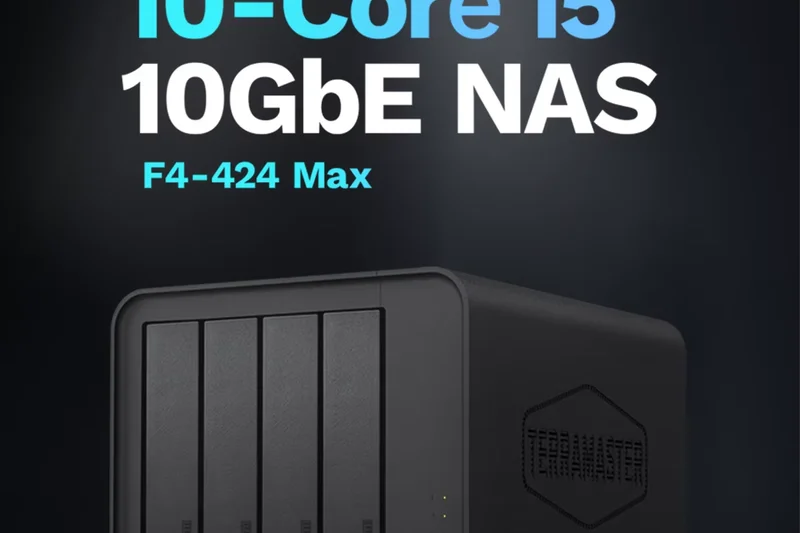
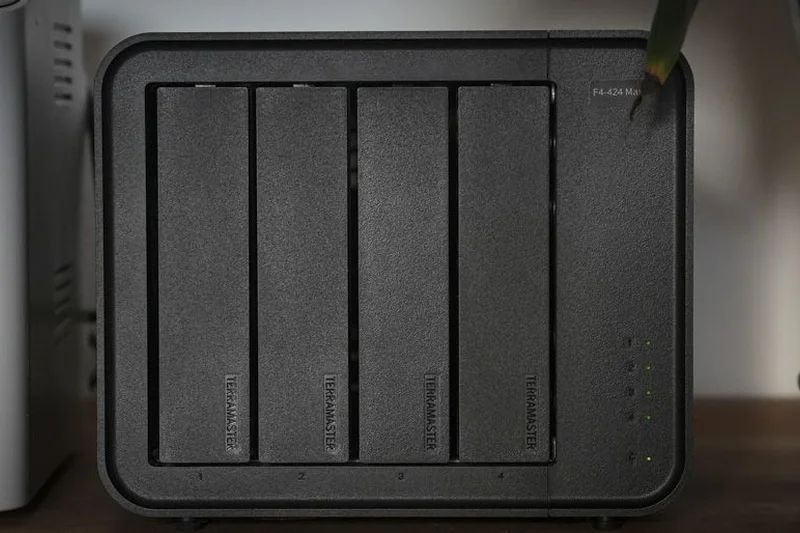
Why we picked it: Earning our #2 spot and taking the crown for Networking & Connectivity, the TerraMaster F4-424 Max disrupts the mid-range NAS market with specifications typically reserved for devices twice its price. Powered by a desktop-class Intel Core i5-1235U 10-Core CPU, this 4-bay NAS effortlessly chews through heavy virtualization workloads, Plex media servers, and intensive database queries. TerraMaster has generously equipped it with 8GB of cutting-edge DDR5 RAM, which can be expanded to 64GB for power users. The standout feature, however, is the inclusion of dual 10GbE Ethernet ports out of the box. In an era where large video files and heavy backups are the norm, this provides an immediate 10x bandwidth boost over standard gigabit networks without requiring expensive PCIe expansion cards. The toolless drive installation is a quality-of-life upgrade that home lab builders will appreciate, and the dual M.2 NVMe PCIe 4.0 slots allow for highly responsive solid-state caching. While TerraMaster's TOS operating system historically lagged behind industry leaders, recent updates have massively improved its stability, security, and app support. At $899, the F4-424 Max offers an unbeatable hardware-to-price ratio.
Key Specs
- Intel Core i5-1235U 10-Core CPU
- 8GB DDR5 RAM (expandable to 64GB)
- Dual 10GbE Ethernet Ports
- 4x HDD Bays + 2x M.2 NVMe PCIe 4.0 Slots
- Toolless drive installation
What we like
- Unbeatable CPU power for the price with a 10-core Intel Core i5
- Dual 10GbE ports out of the box
- Fast DDR5 memory support up to 64GB
- Toolless design makes drive swapping effortless
What we don't like
- TOS software still lacks some advanced enterprise features
- Chassis design is functional but slightly bulky
Best for: Home lab enthusiasts and video editors looking for maximum raw hardware performance on a budget.
Considering the TerraMaster F4-424 Max vs the QNAP TS-464? The TerraMaster dominates in CPU compute and networking speed, making it superior for VMs and large file transfers, though QNAP's software ecosystem is more mature.
A hardware juggernaut that brings Intel Core i5 processing and dual 10GbE to the home office at a highly competitive price.
Buy at TerraMaster official site#3 QNAP TVS-h674-i5
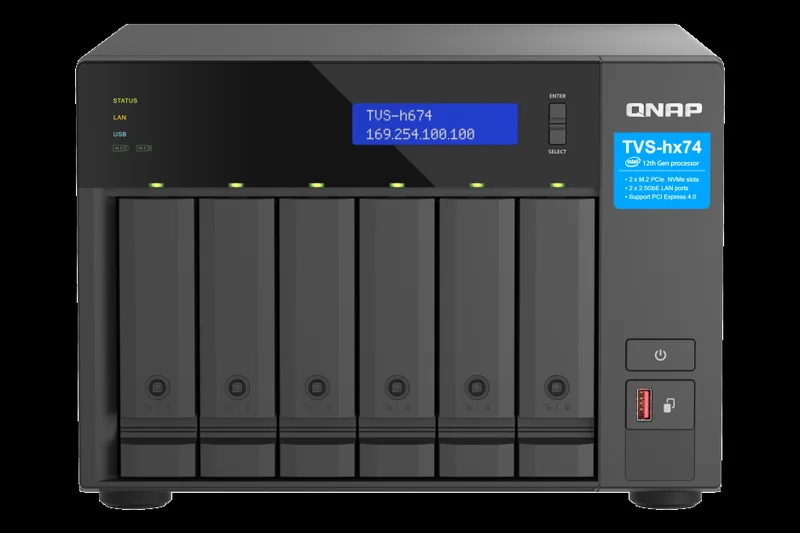
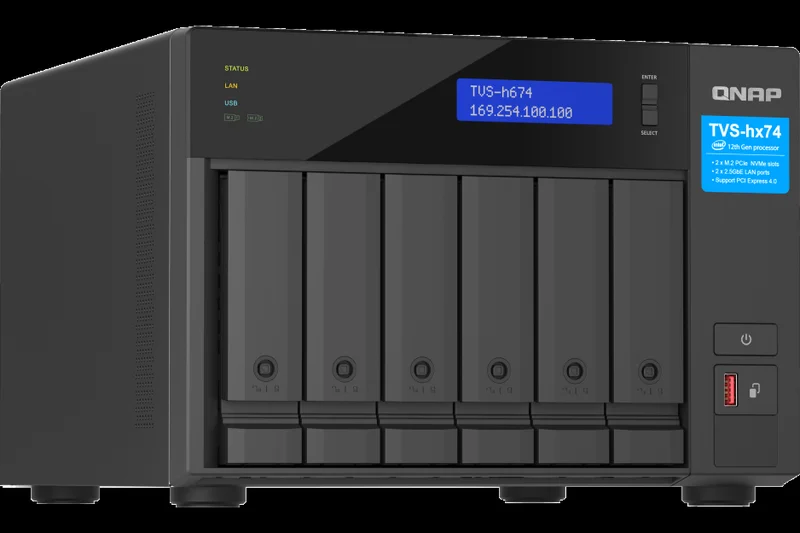
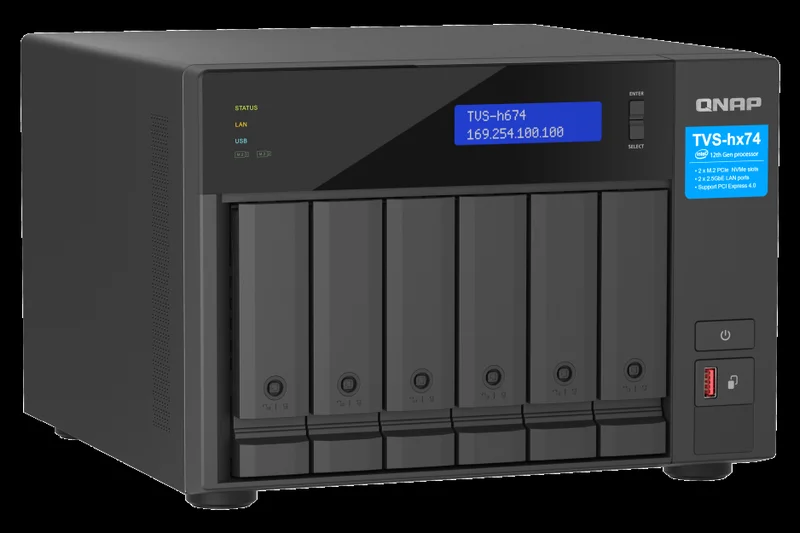
Why we picked it: Ranking #3 overall and dominating our 'Virtualization & Home Lab' scenario, the QNAP TVS-h674-i5 is a heavy-duty 6-bay desktop NAS built for intensive compute workloads. It earned a perfect 10/10 in our Computing Performance dimension thanks to its beastly Intel Core i5-12400 6-Core CPU and 32GB of pre-installed DDR4 RAM. This isn't just a storage box; it's a fully capable hypervisor. Using QNAP's Virtualization Station, you can easily spin up multiple Windows or Linux VMs, route graphics workloads by installing a dedicated GPU in one of the dual PCIe Gen 4 slots, and run dozens of Docker containers simultaneously. The 6-bay design offers excellent storage flexibility, complemented by dual M.2 PCIe 4.0 NVMe slots for ZFS caching via the robust QuTS hero operating system. QuTS hero brings enterprise-grade data protection, including inline data deduplication, compression, and near-limitless snapshots. Out of the box, it features dual 2.5GbE LAN ports, and the PCIe slots allow easy upgrades to 10GbE or 25GbE. For the dedicated home lab tinkerer or small business needing an all-in-one server and storage appliance, the TVS-h674-i5 is unmatched.
Key Specs
- Intel Core i5-12400 6-Core CPU
- 32GB DDR4 SODIMM RAM
- 6x 3.5-inch + 2x M.2 PCIe 4.0 NVMe
- 2x 2.5GbE LAN Ports
- Dual PCIe Gen 4 expansion slots for GPU or 10GbE
What we like
- Desktop-class Intel Core i5 CPU destroys virtualization workloads
- ZFS-based QuTS hero OS offers elite data integrity
- Dual PCIe Gen 4 slots for immense expandability (GPU/NICs)
- Huge 32GB RAM capacity out of the box
What we don't like
- High initial price tag
- Larger footprint and can get noisy under heavy CPU loads
Best for: IT professionals, developers, and serious home lab builders running multiple virtual machines.
Considering the QNAP TVS-h674-i5 vs the Asustor Lockerstor 4 Gen3? The QNAP provides superior expandability with its PCIe slots and ZFS support, while the Asustor is more compact and includes 10GbE natively.
A top-tier virtualization powerhouse that blurs the line between a traditional NAS and a high-performance home server.
Buy at QNAP official site#4 UGREEN NASync DXP6800 Pro
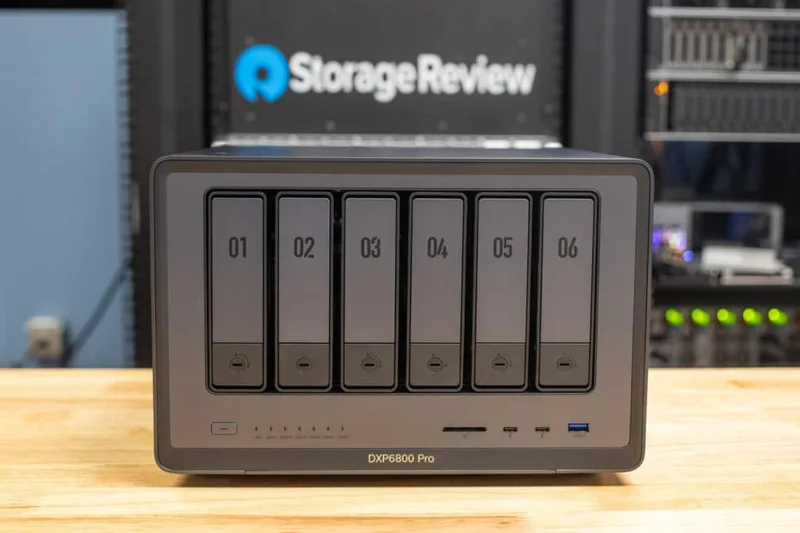
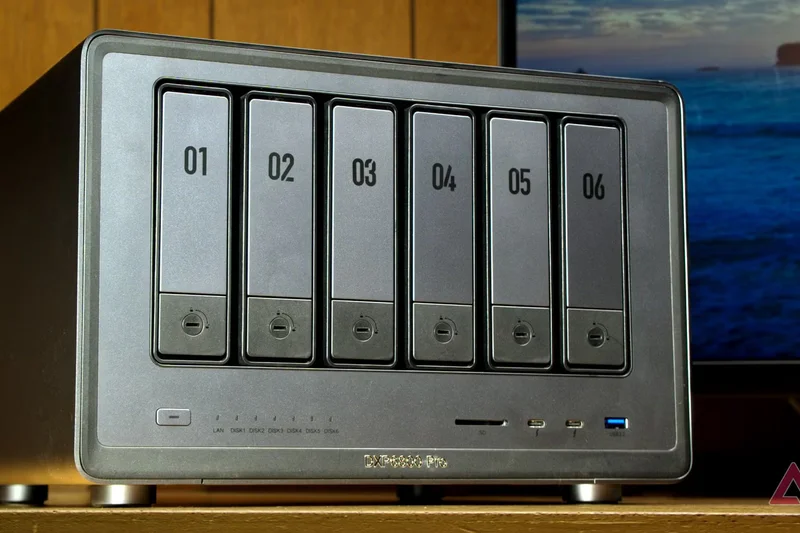
Why we picked it: Securing the #4 spot, the UGREEN NASync DXP6800 Pro proves that UGREEN is a serious contender in the high-end NAS market. Packed with an Intel Core i5-1235U 10-core CPU and dual 10GbE ports, it brings immense bandwidth to content creators and data-heavy professionals. The inclusion of dual Thunderbolt 4 ports makes it incredibly versatile, allowing for blazing-fast direct-attached connections. While its software ecosystem is still evolving compared to legacy brands, the sheer hardware value and sleek design make it a standout choice for those needing fast 6-bay storage.
Key Specs
- Intel Core i5-1235U 10-Core CPU
- 8GB DDR5 RAM (expandable to 64GB)
- Dual 10GbE Ports
- 6x HDD Bays + 2x M.2 NVMe Slots
- 2x Thunderbolt 4 Ports
What we like
- Dual 10GbE and Thunderbolt 4 ports
- Premium aluminum build quality
- Powerful 10-core Intel processor
What we don't like
- UGREEN's OS is still maturing
- App ecosystem is relatively limited
Best for: Video editors and tech-savvy users prioritizing hardware specs and direct Thunderbolt connectivity.
Compared to Synology, the UGREEN offers drastically better hardware for the price, but Synology wins decisively on software refinement.
A beautifully designed hardware beast that challenges the old guard with elite networking and Thunderbolt 4.
Buy at UGREEN official site#5 AOOSTAR WTR PRO
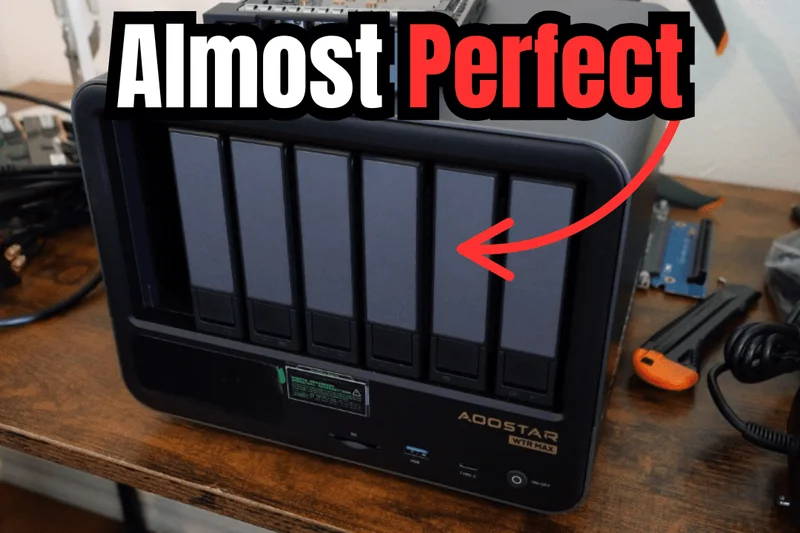
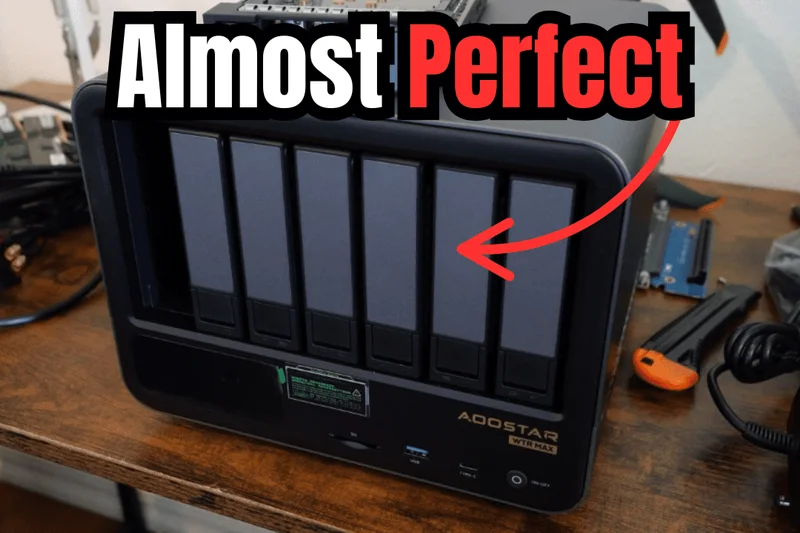
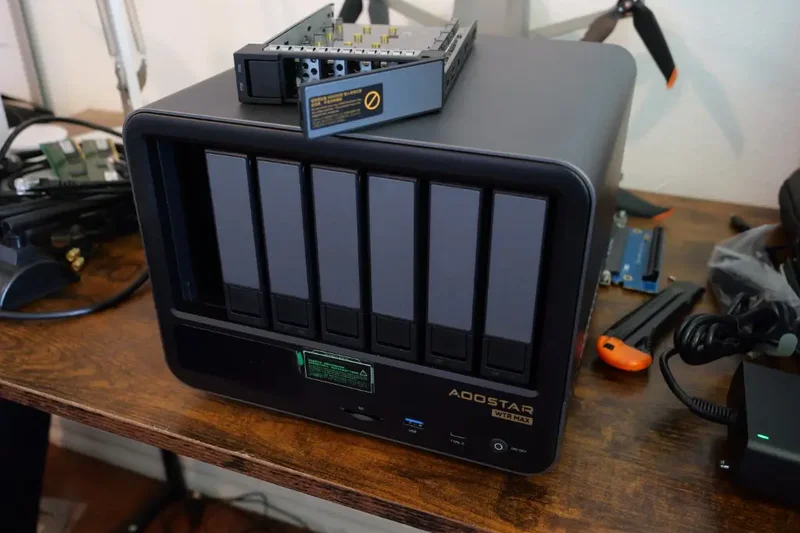
Why we picked it: Taking our award for 'Best Budget Entry-Level Server', the AOOSTAR WTR PRO is a fascinating hybrid device. For just $350, you get an AMD Ryzen 7 5825U 8-Core CPU in a compact 4-bay chassis. Because it comes pre-installed with Windows 11 Pro, it serves double duty as a standard mini-PC and a robust home server. Dual 2.5GbE ports ensure fast network transfers, and the hardware easily handles hypervisors like Proxmox or Hyper-V. It’s an unbeatable value for tinkerers on a budget.
Key Specs
- AMD Ryzen 7 5825U 8-Core CPU
- Up to 64GB DDR4 RAM
- Dual 2.5GbE Ports
- 4x 3.5/2.5-inch SATA Bays
- Pre-installed Windows 11 Pro
What we like
- Unbelievable price-to-performance ratio
- 8-core Ryzen CPU handles VMs with ease
- Windows 11 Pro offers ultimate software flexibility
What we don't like
- Requires more manual setup than a dedicated NAS
- Build quality is plasticky compared to premium brands
Best for: Freelancers and DIY enthusiasts looking for an inexpensive, highly flexible Windows-based home server.
Unlike a QNAP or Synology NAS, the AOOSTAR is essentially a PC; it trades dedicated storage OS polish for absolute freedom to install whatever you want.
The ultimate DIY home server platform, offering Ryzen 7 power and 4 drive bays at an entry-level price.
Check price at Amazon#6 HPE ProLiant MicroServer Gen10 Plus v2
Why we picked it: The HPE ProLiant MicroServer Gen10 Plus v2 brings authentic enterprise reliability to the home office. Scoring highly in Security and Management, it features HPE's industry-leading iLO5 silicon root of trust and remote management capabilities. Its ultra-compact tower design holds four LFF SATA drives and utilizes ECC RAM paired with a Xeon E-2300 series processor. For small businesses that demand traditional server architecture in a tiny footprint, this is a proven, rock-solid workhorse.
Key Specs
- Intel Xeon E-2300 or Pentium G Series CPU
- Up to 64GB DDR4 ECC RAM
- 4x LFF SATA Drive Bays
- Quad 1GbE Ports
- HPE iLO5 Management integration
What we like
- Enterprise-grade iLO5 remote management
- Extremely compact and well-built chassis
- Xeon processor with ECC memory support
What we don't like
- Only gigabit networking natively
- iLO Advanced license costs extra
Best for: Small business owners requiring enterprise-level remote management and reliability in a micro footprint.
Unlike consumer NAS devices, the HPE MicroServer is a true enterprise server, offering deeper hardware management but requiring more IT knowledge to deploy.
A miniaturized enterprise server that delivers unrivaled reliability and remote management for critical home office tasks.
Check price at Amazon#7 TerraMaster F8 SSD Plus
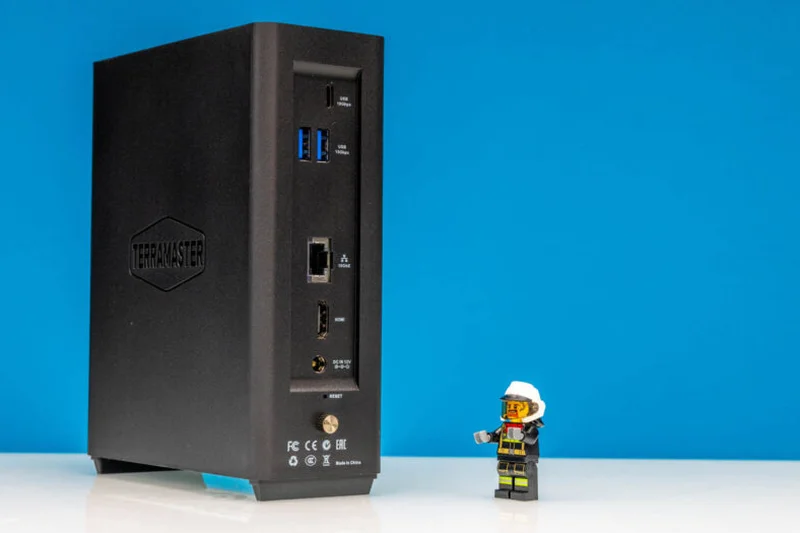
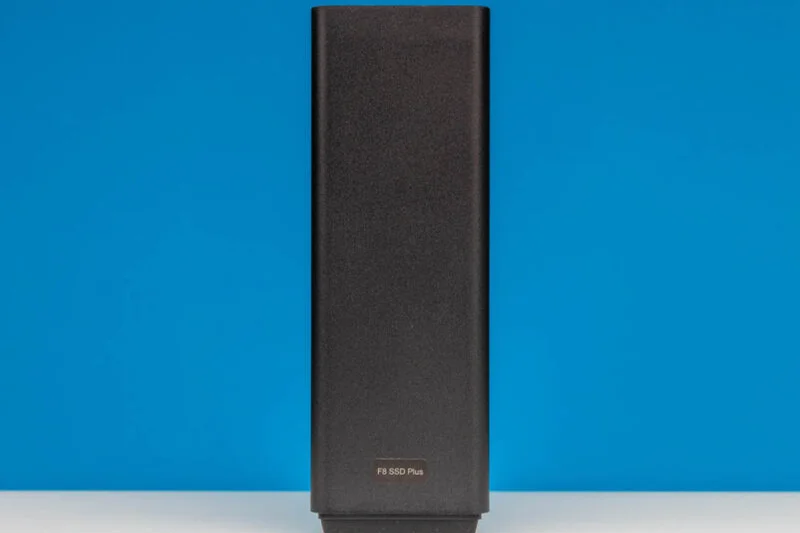
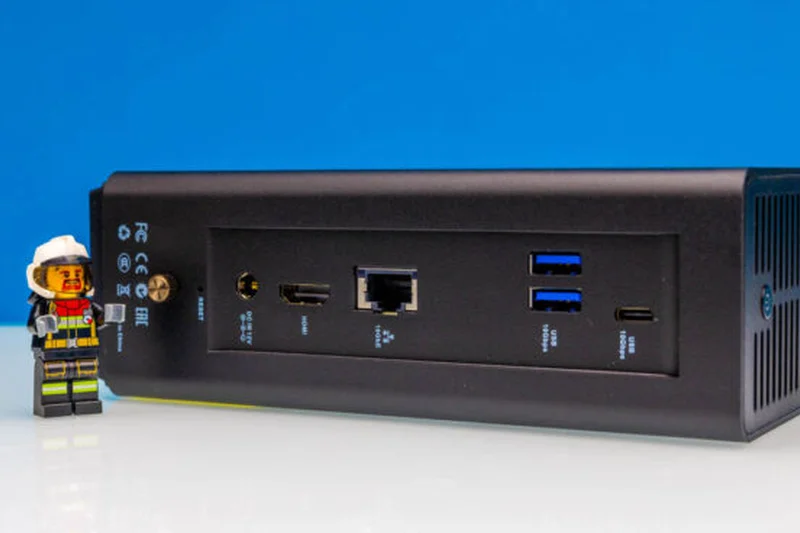
Why we picked it: Winning our 'Form Factor & Acoustics' award, the TerraMaster F8 SSD Plus is a marvel of miniaturization. This palm-sized, all-flash NAS houses eight M.2 NVMe SSDs, operating in near-total silence. Powered by an Intel Core i3-N305 and boasting a 10GbE port, it delivers blazing-fast I/O without the bulk or vibration of traditional hard drives. It is the perfect desk companion for audio engineers or video editors who demand zero background noise and high-speed storage.
Key Specs
- Intel Core i3-N305 8-Core CPU
- 16GB DDR5 4800MHz RAM
- 8x M.2 NVMe 2280 SSD Slots
- 1x 10GbE Ethernet Port
- Ultra-compact palm-sized design
What we like
- Whisper-quiet, all-flash zero-vibration operation
- Incredibly small footprint
- Built-in 10GbE for massive data throughput
What we don't like
- M.2 NVMe drives are expensive to populate fully
- Limited to flash storage only (no HDD bays)
Best for: Audio/video professionals who need dead-silent, high-speed 10GbE storage directly on their desk.
Compared to the Asustor Flashstor, the TerraMaster F8 SSD Plus offers a faster CPU and 10GbE natively, making it a stronger performer for intensive tasks.
A revolutionary palm-sized NAS that proves you don't need a massive tower to achieve multi-gigabit speeds and 8-drive redundancy.
Buy at TerraMaster official site#8 TrueNAS Mini R
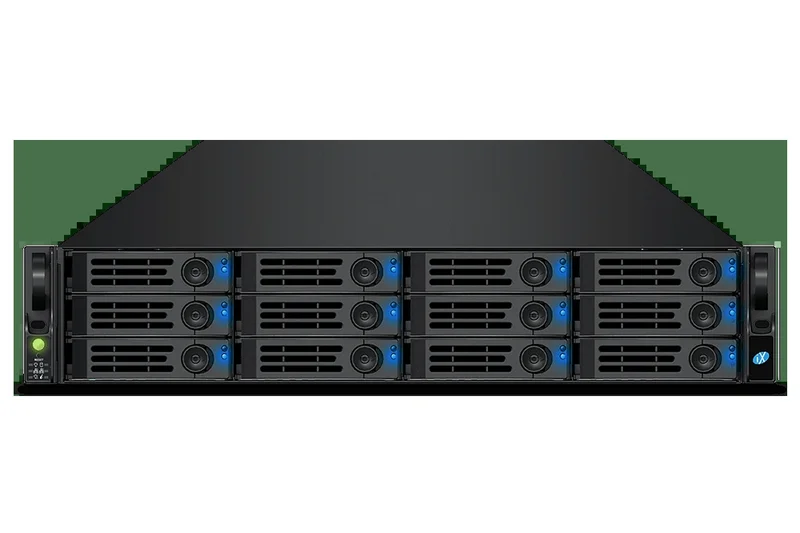
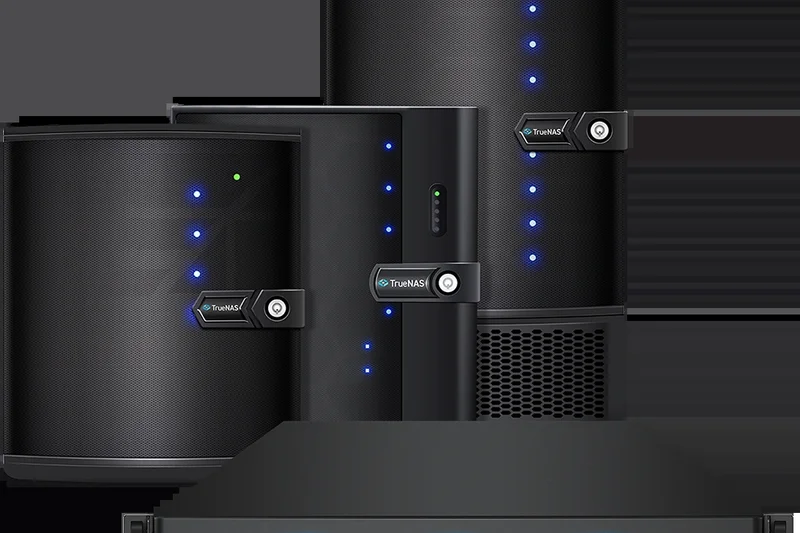
Why we picked it: Taking the top honors for Storage Capacity & Expansion, the TrueNAS Mini R is an uncompromising 12-bay rackmount server designed for serious data hoarders and media professionals. Running the legendary ZFS file system, it provides unparalleled data integrity. With dual 10GbE RJ45 ports and an Intel Atom C3758 processor paired with ECC RAM, it is built to handle massive arrays securely. While it requires a rack or deep shelf, its storage density is unmatched in this price tier.
Key Specs
- Intel Atom C3758 Octa-Core CPU
- 32GB DDR4 ECC RAM (expandable to 64GB)
- 12x 3.5-inch Hot-Swap SATA Bays
- Dual 10GbE RJ45 Ports
- Out-of-band IPMI remote management
What we like
- Massive 12-bay storage capacity
- ZFS file system ensures ultimate data safety
- Dual 10GbE and out-of-band management included
What we don't like
- Rackmount form factor isn't ideal for all home offices
- Louder operation than desktop NAS units
Best for: Content creators and IT pros needing massive, highly secure ZFS storage pools.
Compared to commercial NAS brands, TrueNAS offers superior data integrity via ZFS, but requires a slightly steeper learning curve.
An absolute storage behemoth that brings enterprise ZFS data protection and 12 bays of expansion to the prosumer space.
Buy at TrueNAS official site#9 QNAP TVS-h674-i3
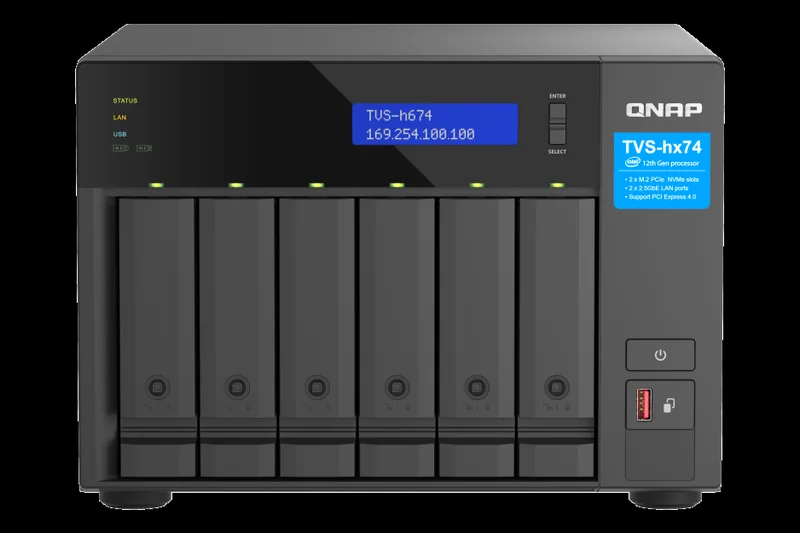
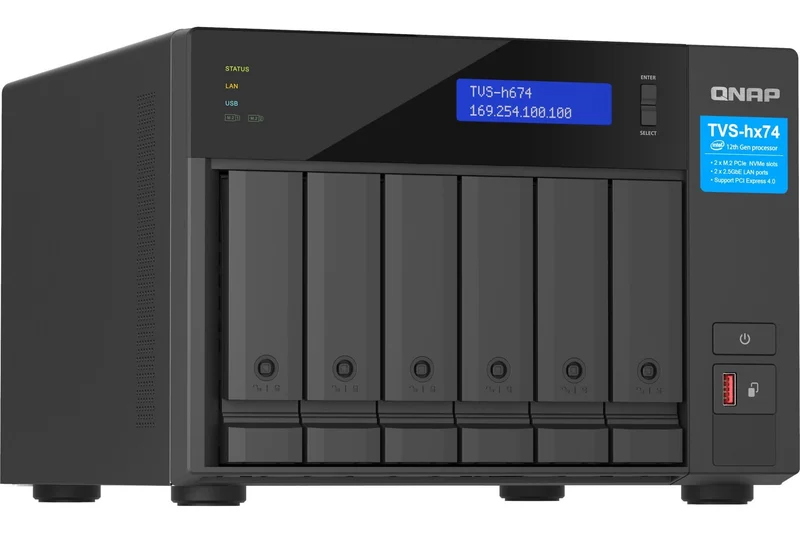
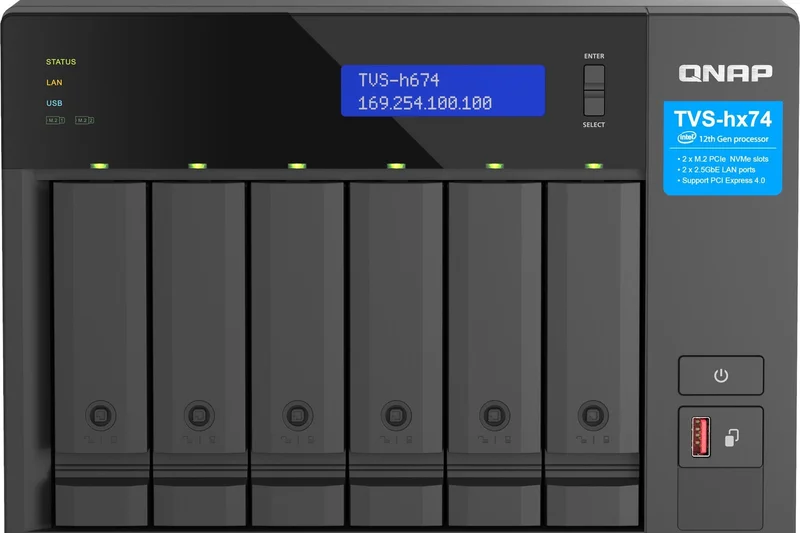
Why we picked it: The i3 variant of the QNAP TVS-h674 series offers the same excellent 6-bay expansion and ZFS capabilities as its bigger sibling, but at a more accessible $1,200 price point. The Intel Core i3-12100 Quad-Core CPU provides plenty of power for the QuTS hero OS and moderate virtualization tasks. With dual 2.5GbE LAN and dual PCIe Gen 4 slots, it is a highly capable and upgradeable server for advanced home labs.
Key Specs
- Intel Core i3-12100 Quad-Core CPU
- 16GB DDR4 SODIMM RAM
- 6x 3.5-inch + 2x M.2 NVMe
- Dual 2.5GbE LAN
- ZFS-based QuTS hero OS
What we like
- Great balance of CPU power and price
- ZFS data protection via QuTS hero
- Excellent PCIe Gen 4 upgrade path
What we don't like
- Still relatively expensive
- Only 2.5GbE out of the box (requires card for 10GbE)
Best for: Home lab users who want QNAP's elite chassis and ZFS features without paying for the i5 processor.
It trades the raw multi-core dominance of the i5 version for a more palatable price, keeping all the physical expansion intact.
A premium, highly expandable NAS that hits the sweet spot for ZFS performance and budget.
Buy at QNAP official site#10 TerraMaster F4-424 Pro
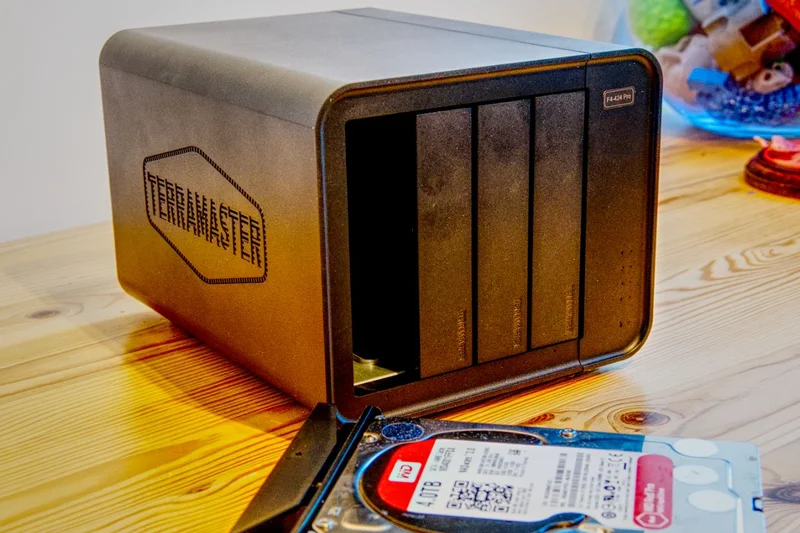
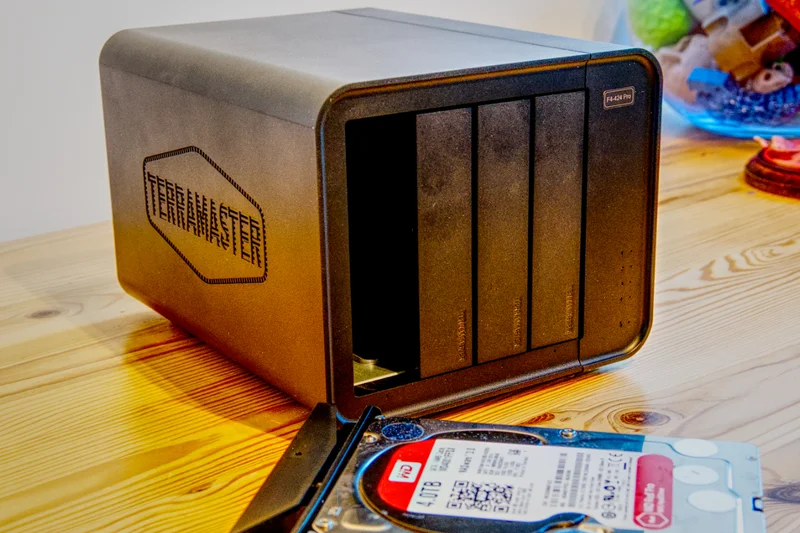
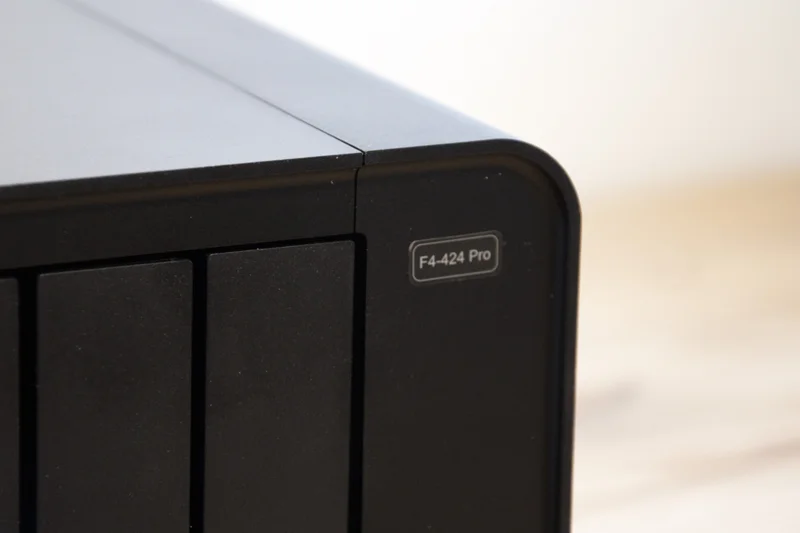
Why we picked it: The TerraMaster F4-424 Pro is an outstanding 4-bay NAS that leverages an Intel Core i3 8-Core processor and a massive 32GB of DDR5 RAM right out of the box. While it drops the 10GbE ports of the 'Max' version in favor of dual 2.5GbE, its generous memory allocation makes it a fantastic Docker and VM host. The new TOS 6 operating system provides a clean, responsive interface for managing your workflows.
Key Specs
- Intel Core i3 8-Core CPU
- 32GB DDR5 RAM
- Dual 2.5GbE Ports
- 4x HDD Bays + 2x M.2 NVMe Slots
- TOS 6 Operating System
What we like
- Massive 32GB of DDR5 RAM pre-installed
- Strong 8-core CPU performance
- Improved TOS 6 software experience
What we don't like
- Lacks the 10GbE ports found on the Max version
- Plastic drive trays feel slightly cheap
Best for: Users needing a memory-heavy server for running numerous background apps and containers.
Compared to the F4-424 Max, the Pro gives you much more RAM out of the box but sacrifices 10GbE networking.
A highly capable mid-range NAS that solves memory bottlenecks for container-heavy home networks.
Buy at TerraMaster official site#11 Synology DiskStation DS1522+
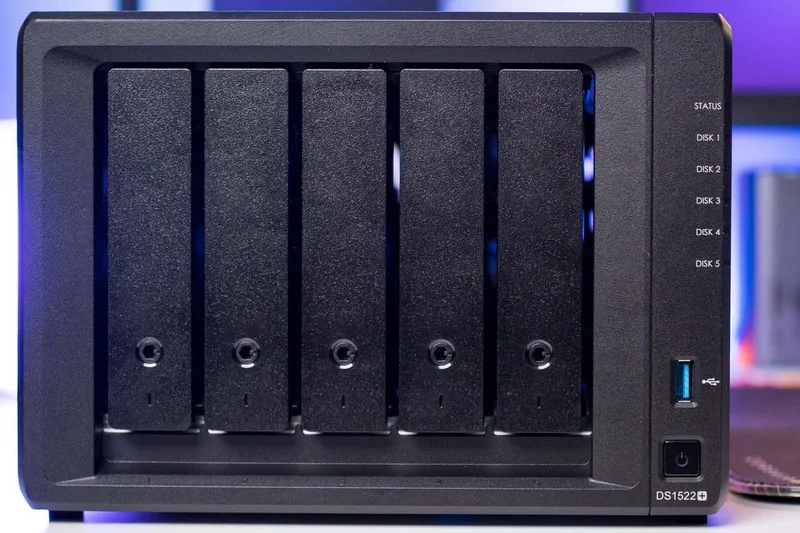
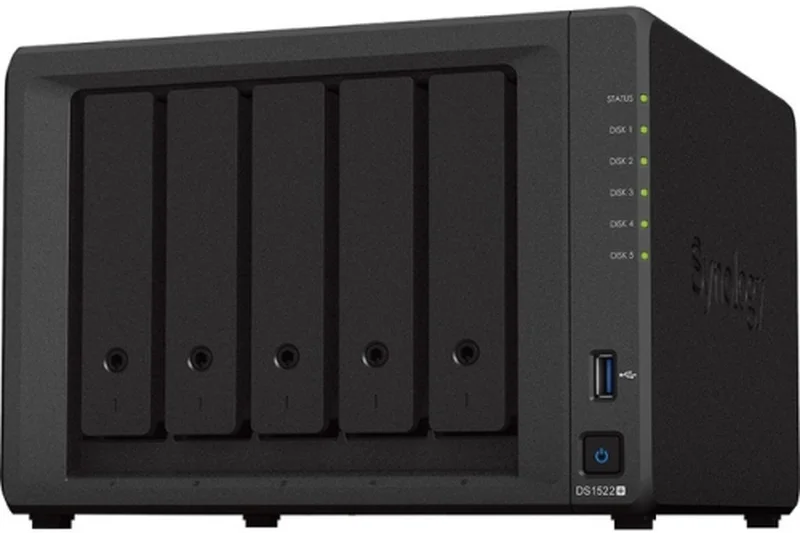
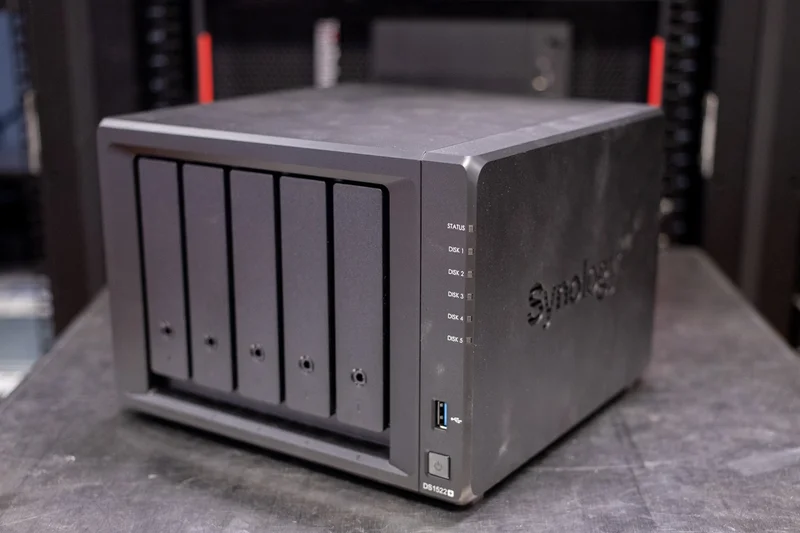
Why we picked it: Synology’s 5-bay DS1522+ remains a favorite for its unparalleled software experience. Earning high marks in Management and Security, DSM (DiskStation Manager) is the gold standard for intuitive server administration. While its dual-core Ryzen R1600 CPU isn't the fastest, the availability of an optional 10GbE module and support for up to 15 drives via expansion units make it incredibly versatile for reliable, hassle-free business backups.
Key Specs
- AMD Ryzen R1600 Dual-Core CPU
- 8GB ECC DDR4 RAM (expandable to 32GB)
- 4x 1GbE Ports (10GbE network module ready)
- 2x M.2 NVMe Caching Slots
- Expandable to 15 bays via DX517
What we like
- Industry-best DSM software ecosystem
- ECC RAM for data integrity
- Easily upgradeable to 10GbE via proprietary slot
What we don't like
- CPU is underpowered compared to newer rivals
- Only 1GbE natively
Best for: Small business owners who prioritize ease of use, reliable backups, and a polished software interface over raw hardware specs.
While TerraMaster and QNAP offer better hardware for the money, Synology’s software is vastly superior for non-IT professionals.
The safest, most user-friendly 5-bay NAS on the market, backed by Synology's legendary software.
Check price at Amazon#12 TrueNAS Mini X
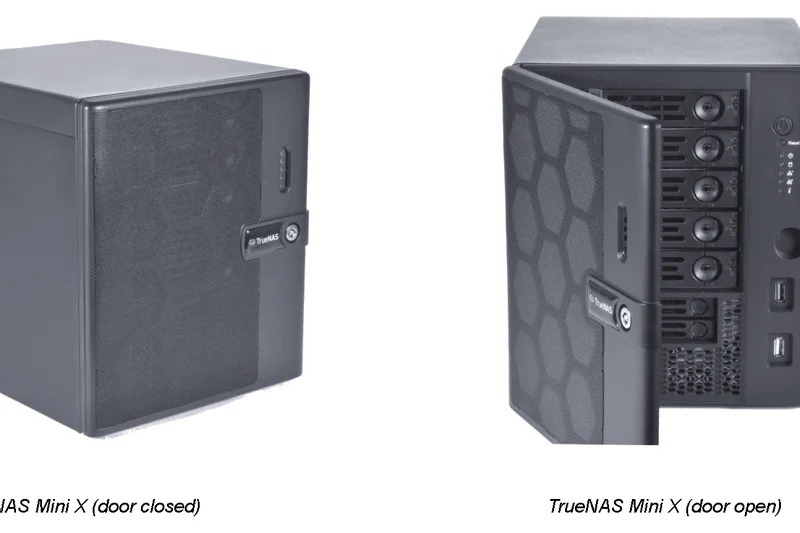
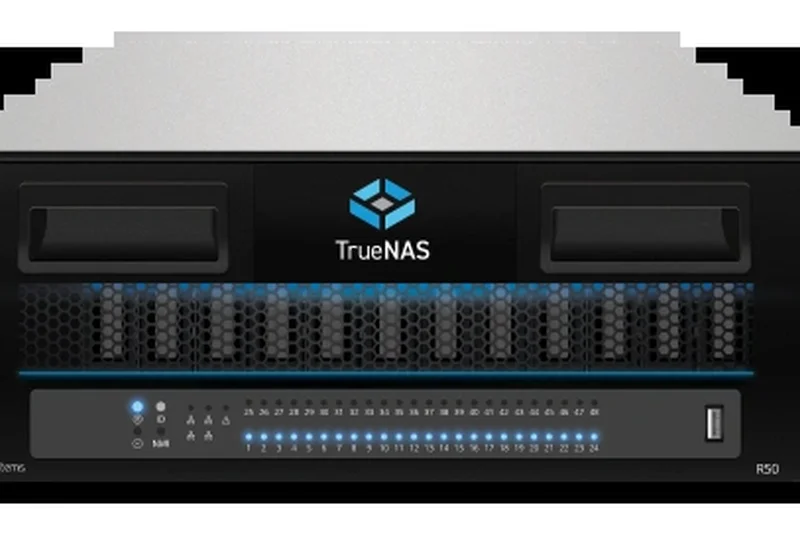
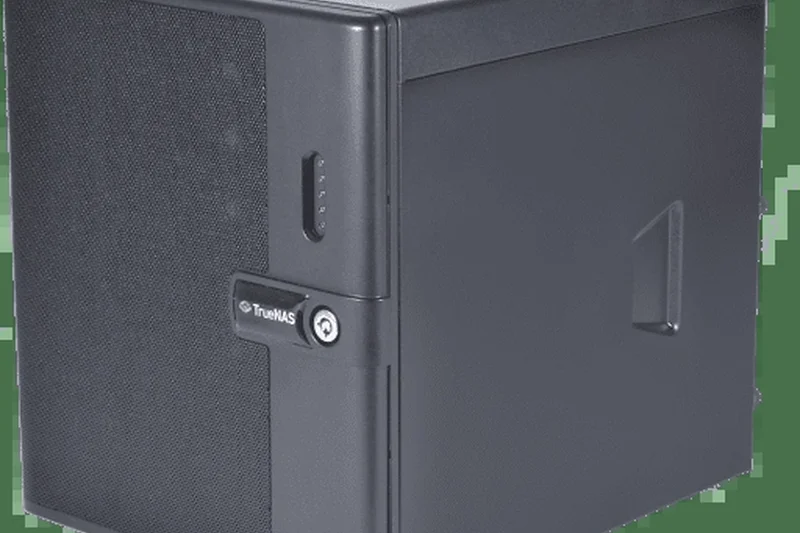
Why we picked it: The TrueNAS Mini X brings the power of open-source TrueNAS CORE/SCALE to a quiet, compact 5-bay desktop enclosure. Featuring an Intel Atom quad-core CPU and 16GB of ECC RAM, it is purpose-built for ZFS storage reliability. The dual 2.5-inch SATA SSD bays allow for dedicated boot or caching drives, freeing up the five 3.5-inch bays for massive capacity. It’s perfect for data purists who want enterprise filesystem features at home.
Key Specs
- Intel Atom C3558 Quad-Core CPU
- 16GB DDR4 ECC RAM
- 5x 3.5-inch Hot-Swap SATA Bays
- 2x 2.5-inch SATA SSD Bays
- Quad 1GbE LAN Ports
What we like
- Native ZFS support with ECC RAM
- Excellent build quality and drive layout
- Runs robust TrueNAS software
What we don't like
- No built-in multi-gigabit networking (only 1GbE)
- Atom CPU is adequate but not designed for heavy VMs
Best for: Data integrity enthusiasts who want a turnkey TrueNAS experience in a compact form factor.
Unlike consumer NAS devices, the Mini X requires some technical know-how to configure ZFS correctly, but rewards users with bulletproof data safety.
A beautifully constructed, data-first storage appliance designed explicitly for the powerful TrueNAS ecosystem.
Buy at TrueNAS official site#13 QNAP TS-464
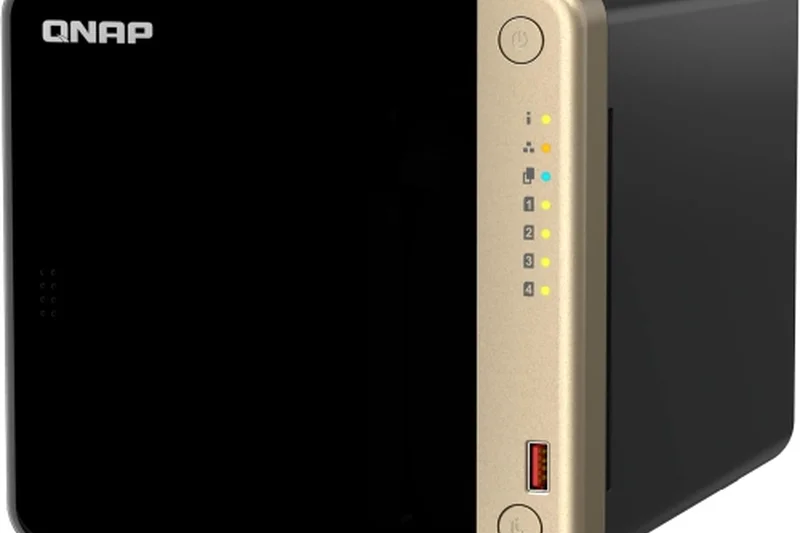
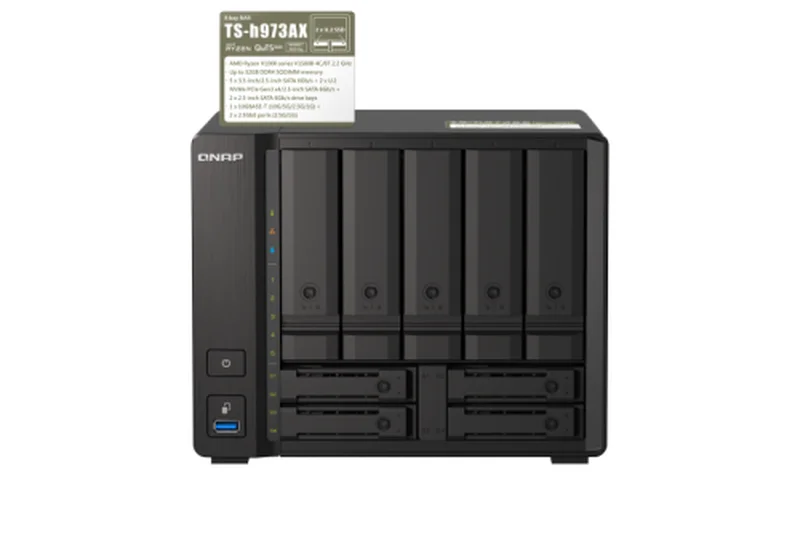
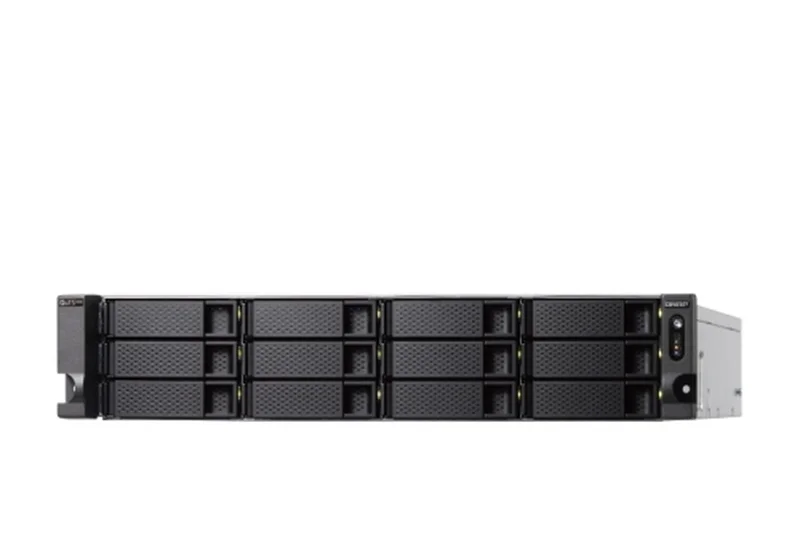
Why we picked it: The QNAP TS-464 is a highly versatile 4-bay NAS that shines as a multimedia hub and competent backup server. Powered by an Intel Celeron N5095 quad-core processor and featuring dual 2.5GbE ports, it offers great bandwidth for everyday file sharing. Uniquely, it includes an HDMI 2.1 port, allowing you to connect it directly to a monitor or TV for media playback or local VM access, making it a highly functional centerpiece for hybrid spaces.
Key Specs
- Intel Celeron N5095 Quad-Core CPU
- 8GB DDR4 RAM
- Dual 2.5GbE Ports
- 2x M.2 NVMe PCIe Gen 3 Slots
- HDMI 2.1 Output for direct display
What we like
- Direct HDMI output is incredibly useful
- Dual 2.5GbE provides solid network speeds
- M.2 NVMe slots allow for fast caching
What we don't like
- PCIe expansion is limited to Gen 3
- Celeron CPU struggles with intense virtualization
Best for: Home office users who also want to use their server as a direct-attached media player or lightweight PC.
Compared to the Synology DS923+, the QNAP TS-464 offers better out-of-the-box networking and a direct HDMI port, though Synology's software is smoother.
A feature-rich, media-friendly 4-bay NAS that delivers strong everyday performance and connectivity.
Buy at QNAP official site#14 QNAP TS-264
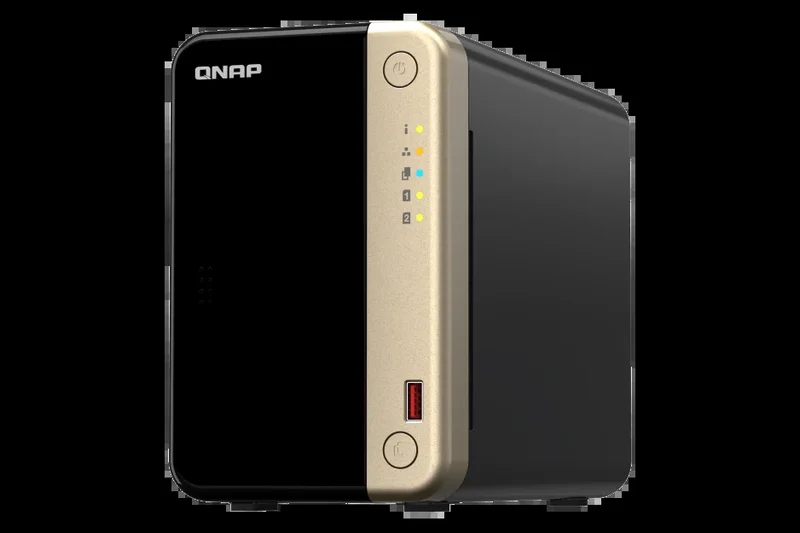

Why we picked it: Essentially the 2-bay sibling to the TS-464, the QNAP TS-264 packs the same robust Celeron N5095 CPU and dual 2.5GbE ports into a smaller footprint. It is ideal for users who don't need the physical storage space of four drives but still want high-speed networking, M.2 NVMe caching, and HDMI output. It handles local backups and Docker containers efficiently without taking up desk space.
Key Specs
- Intel Celeron N5095 Quad-Core CPU
- 8GB DDR4 RAM
- Dual 2.5GbE Ports
- 2x M.2 NVMe PCIe Gen 3 Slots
- HDMI 2.0 Output
What we like
- Excellent hardware specs for a 2-bay unit
- Dual 2.5GbE networking natively
- Compact footprint
What we don't like
- Limited to 2 drives (RAID 1 max for redundancy)
- Pricey for a 2-bay device
Best for: Space-constrained professionals who want premium networking and caching in a small 2-bay NAS.
It beats most 2-bay competitors by including dual 2.5GbE and M.2 slots, distinguishing itself from basic entry-level models.
A premium 2-bay NAS that refuses to compromise on networking or caching features.
Buy at QNAP official site#15 Dell PowerEdge T150 Tower Server
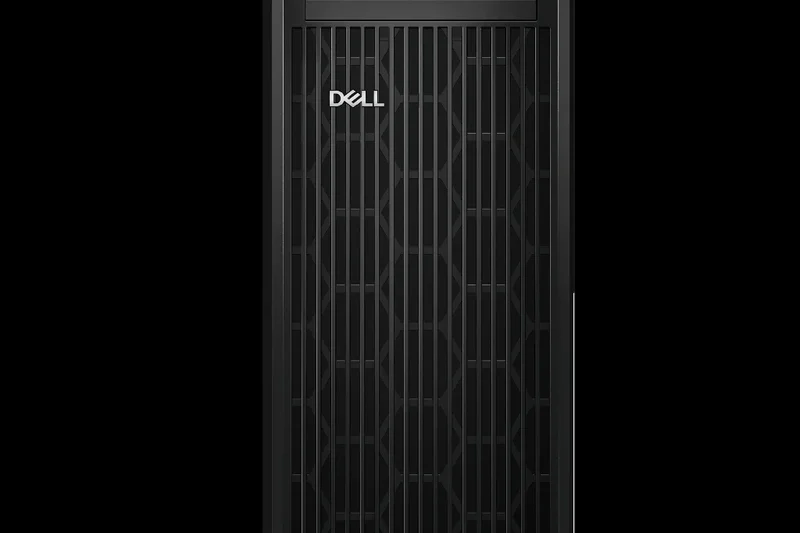
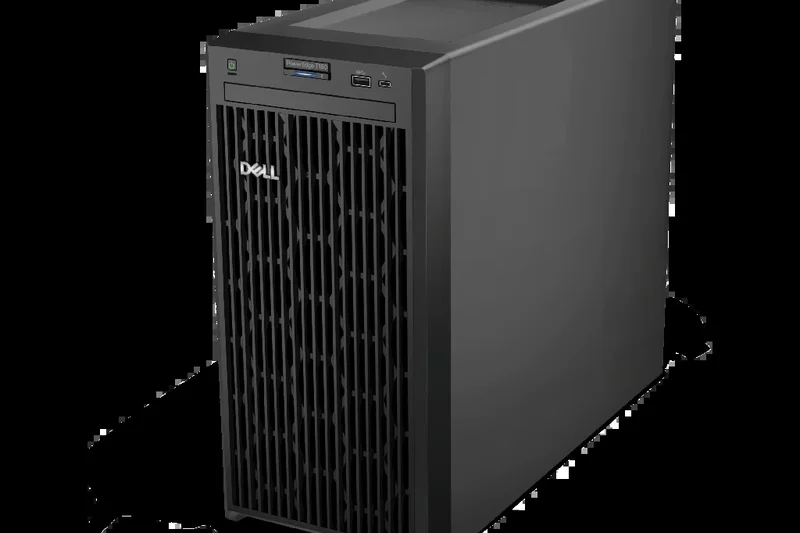
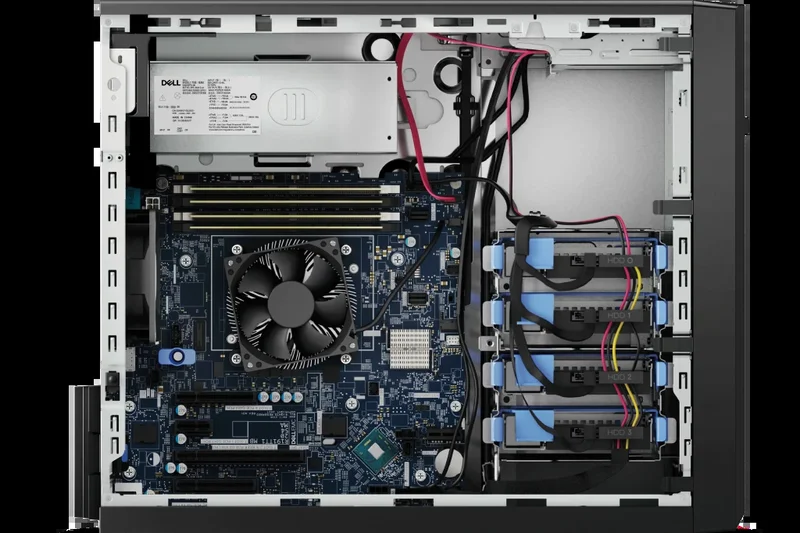
Why we picked it: The Dell PowerEdge T150 is a compact tower server that provides true enterprise IT management to the home office. Featuring the renowned iDRAC9 remote management controller, you get granular control over the hardware, regardless of physical proximity. With an Intel Xeon E-2300 CPU and support for 128GB of ECC RAM, it is a fantastic host for Windows Server or VMware, offering rock-solid stability for business applications.
Key Specs
- Intel Xeon E-2300 Series CPU
- Up to 128GB DDR4 ECC RAM
- 4x 3.5-inch Cabled HDDs
- PCIe Gen4 Expansion slots
- iDRAC9 Remote Management
What we like
- iDRAC9 offers best-in-class remote management
- High RAM ceiling (128GB ECC)
- Robust, enterprise-grade build quality
What we don't like
- Uses cabled HDDs rather than hot-swap bays
- Base configuration is barebones
Best for: Small businesses with remote IT administrators who demand Dell's enterprise reliability.
Unlike NAS devices, the T150 is a blank slate server; it requires an OS installation but offers deeper hardware management.
A dependable, enterprise-grade mini-tower offering top-tier remote management for critical business infrastructure.
Buy at Dell official site#16 Synology DiskStation DS923+
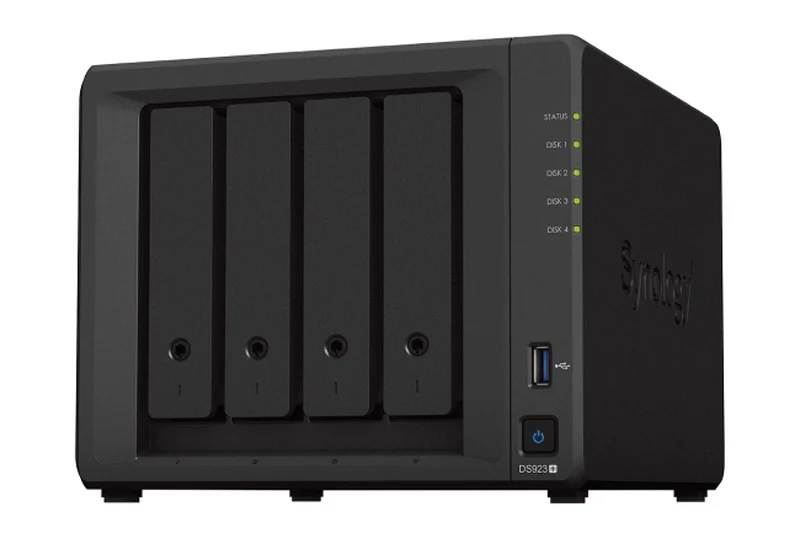
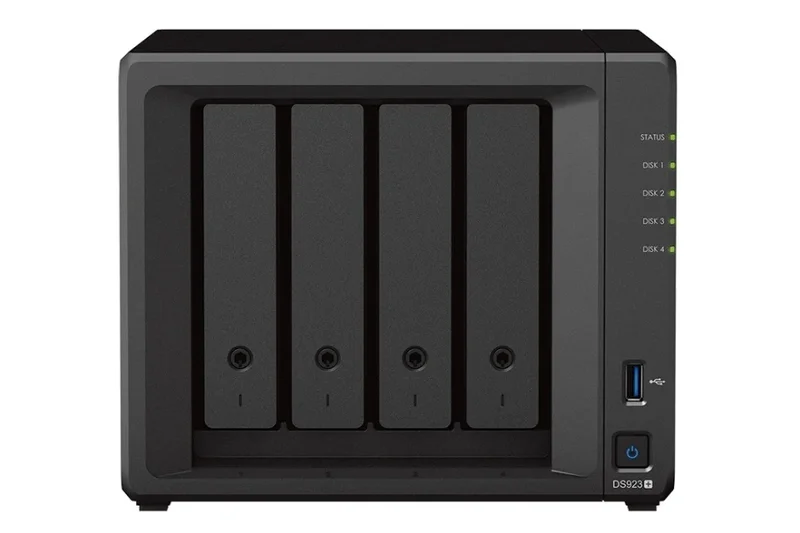
Why we picked it: Winning our 'Software' and 'Security' awards, the Synology DS923+ is a beloved 4-bay NAS that emphasizes stability and ease of use. While its networking is limited to 1GbE out of the box, it features a proprietary upgrade slot for a 10GbE module. The Ryzen R1600 CPU and ECC memory handle Synology's active backup suite flawlessly. For users terrified of command lines, this is the safest, most reliable choice.
Key Specs
- AMD Ryzen R1600 Dual-Core CPU
- 4GB DDR4 ECC RAM (expandable to 32GB)
- 2x 1GbE Ports (10GbE upgrade module supported)
- 2x M.2 NVMe SSD Caching Slots
- Expandable up to 9 drives via DX517
What we like
- Unmatched software UI and backup tools
- ECC memory support
- Expandable to 9 drives
What we don't like
- Ships with only 1GbE ports
- Proprietary 10GbE upgrade module is expensive
Best for: Users prioritizing a seamless, secure software experience and automated backups over raw hardware speed.
Hardware-wise it falls behind TerraMaster and QNAP, but Synology's DSM software remains the undisputed king of usability.
The gold standard for reliable, user-friendly home office storage and automated backups.
Buy at Synology official site#17 UGREEN NASync DXP4800 Plus
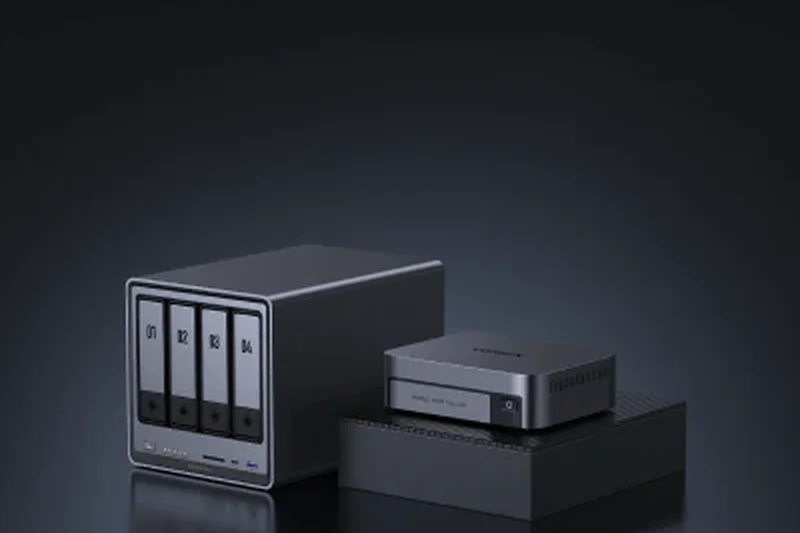
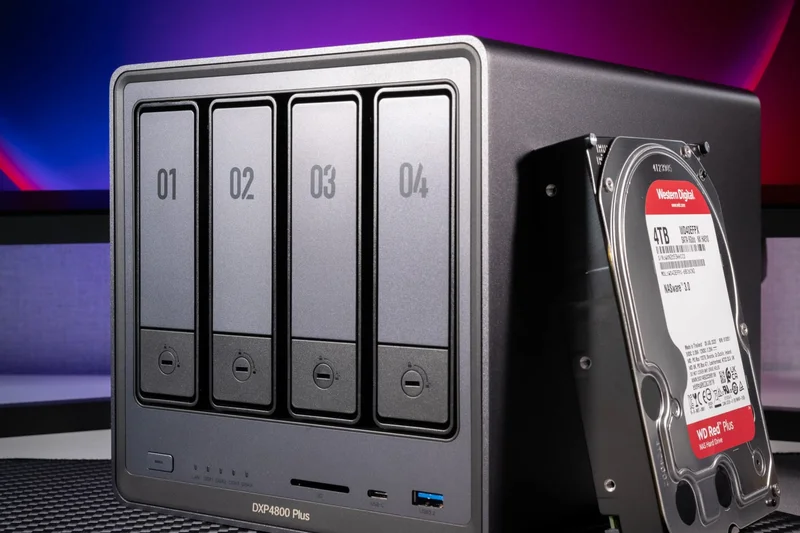
Why we picked it: The 4-bay UGREEN DXP4800 Plus leverages an Intel Pentium Gold 8505 5-core CPU to deliver excellent multitasking capabilities. Equipped with both a 10GbE and a 2.5GbE port, it ensures your local network never bottlenecks your file transfers. The 4K HDMI output and premium metal chassis give it a sleek, modern feel, making it an excellent all-around performer for users willing to try a newer software ecosystem.
Key Specs
- Intel Pentium Gold 8505 5-Core CPU
- 8GB DDR5 RAM (expandable to 64GB)
- 1x 10GbE & 1x 2.5GbE Network Ports
- 4x HDD Bays + 2x M.2 NVMe Slots
- 4K HDMI Output
What we like
- Incredible networking setup (10GbE + 2.5GbE)
- Premium aluminum chassis
- Strong 5-core CPU for media and files
What we don't like
- UGREEN NAS OS lacks advanced enterprise integrations
- A somewhat untested brand in the long-term NAS space
Best for: Tech-savvy users looking for high-end hardware and build quality at a mid-range price.
Offers better networking than Synology's DS923+, but requires patience as its OS features continue to develop.
A beautifully built, high-spec 4-bay NAS that promises massive network throughput for modern offices.
Buy at UGREEN official site#18 Asustor Flashstor 6 FS6706T
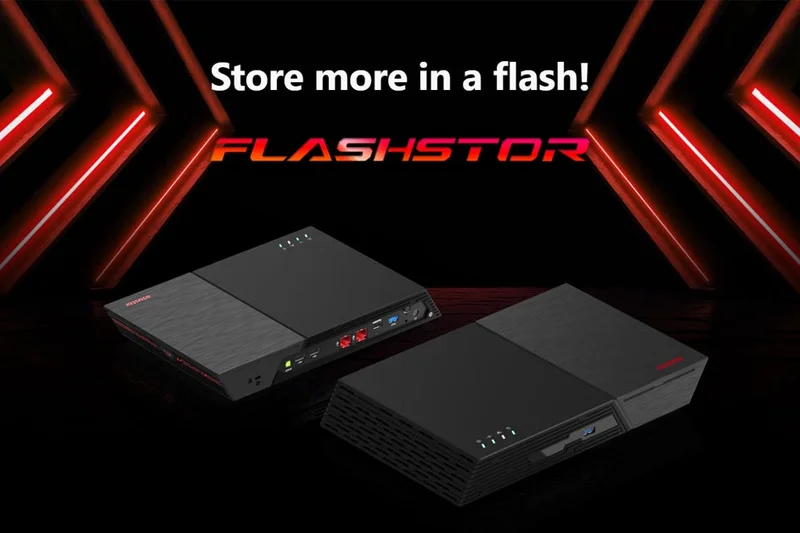
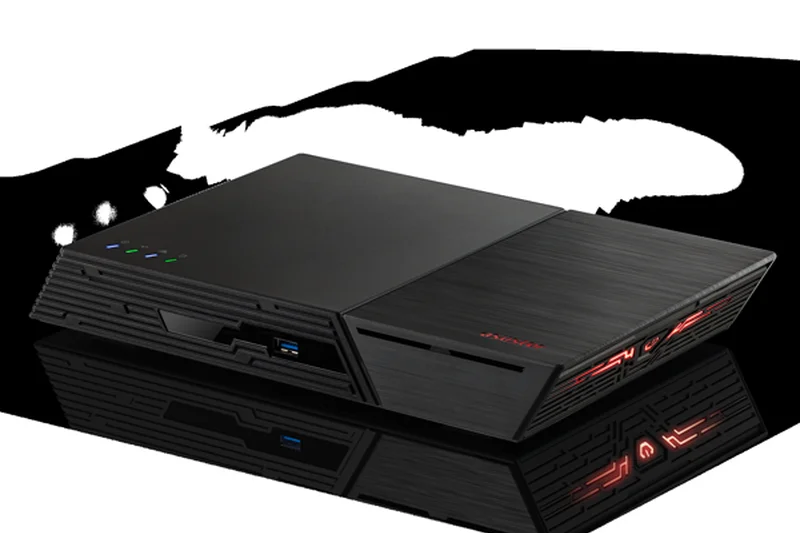
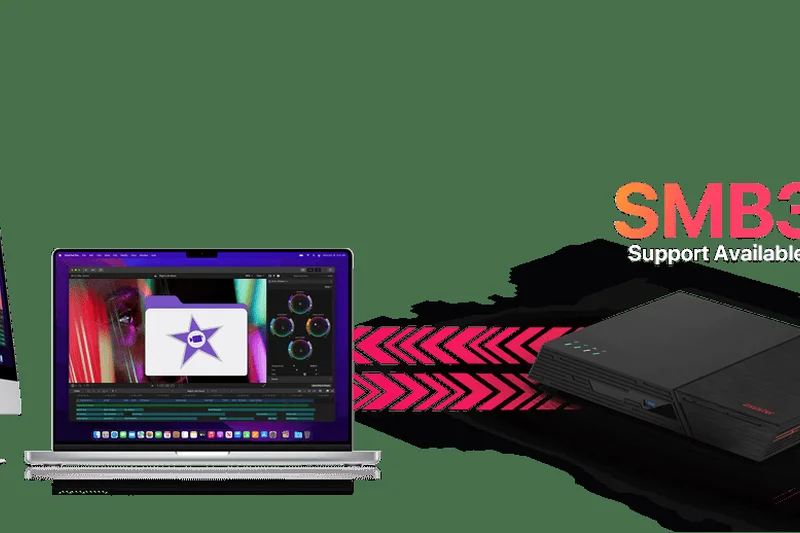
Why we picked it: The Asustor Flashstor 6 completely reimagines NAS design by ditching spinning hard drives entirely. This low-profile, console-like device holds six M.2 NVMe SSDs, operating in near silence. With dual 2.5GbE ports and an Intel Celeron N5105, it is perfect for high-speed local file access. Its unique aesthetic and silent operation make it ideal for placement directly on a desk or in a home theater setup.
Key Specs
- Intel Celeron N5105 Quad-Core CPU
- 4GB DDR4-2933 RAM (expandable to 16GB)
- 6x M.2 NVMe SSD Slots
- Dual 2.5GbE Ports
- S/PDIF output for high-res audio
What we like
- Sleek, silent, all-flash design
- Excellent media capabilities with S/PDIF and HDMI
- Dual 2.5GbE connectivity
What we don't like
- Populating 6 NVMe drives is expensive
- Cooling fan can spin up under heavy NVMe load
Best for: Audiophiles and media enthusiasts wanting a fast, HDD-free storage solution.
A more affordable alternative to the TerraMaster F8 SSD Plus, trading 10GbE for dual 2.5GbE and a sleek console design.
An innovative, all-flash NAS that eliminates hard drive noise and vibrations completely.
Check price at Amazon#19 Asustor Nimbustor 2 Gen2 AS5402T
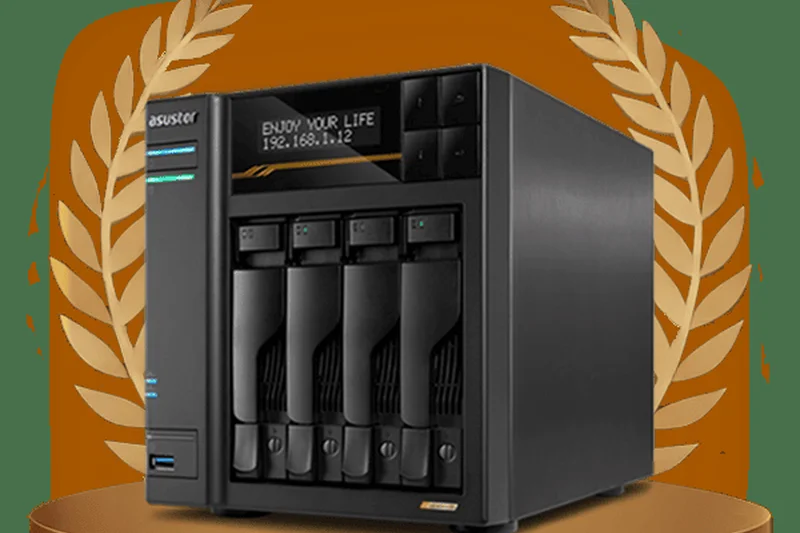
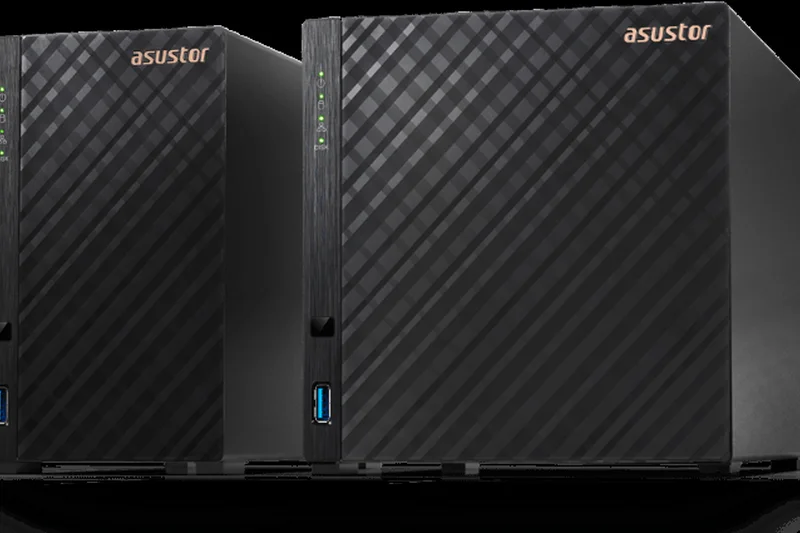
Why we picked it: The Asustor Nimbustor 2 Gen2 is one of the most powerful 2-bay NAS devices available. Aimed at gamers and content creators, it features an Intel Celeron N5105 CPU, dual 2.5GbE ports, and an impressive four M.2 NVMe slots for massive caching or dedicated flash volumes. The gamer-inspired aesthetic might not suit every office, but its performance metrics are undeniably strong for a 2-bay unit.
Key Specs
- Intel Celeron N5105 Quad-Core CPU
- 4GB DDR4 RAM (expandable to 16GB)
- Dual 2.5GbE Ports with Link Aggregation
- 4x M.2 NVMe SSD Slots
- HDMI 2.0b Port for 4K video playback
What we like
- Four M.2 slots in a 2-bay device is incredibly rare
- Dual 2.5GbE ports support link aggregation
- HDMI 2.0b for smooth 4K output
What we don't like
- Gamer aesthetic may clash with professional office decor
- Only 2 main HDD bays limits long-term capacity
Best for: Streamers and creators who want extreme performance and caching in a 2-bay form factor.
Outpaces standard 2-bay models by offering four NVMe slots, making it vastly superior for IOPS-heavy workloads.
A highly specialized 2-bay NAS delivering top-tier network and cache performance.
Check price at Amazon#20 Asustor Lockerstor 2 Gen2 AS6702T
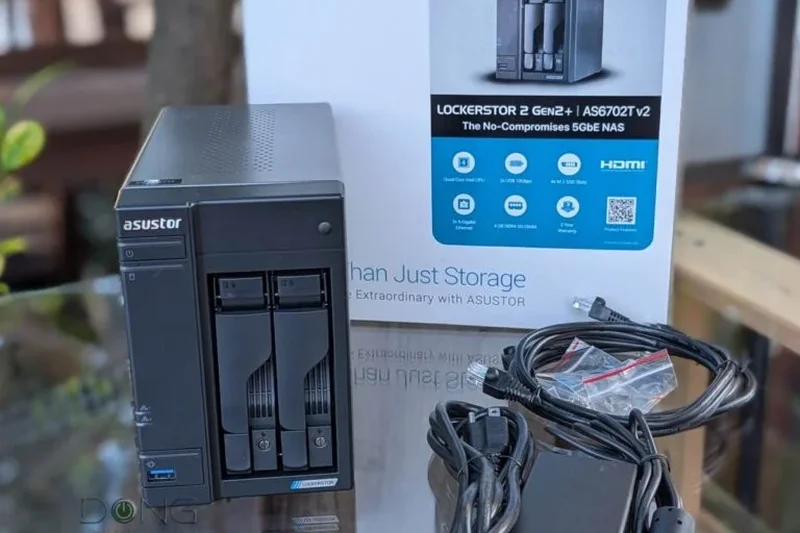
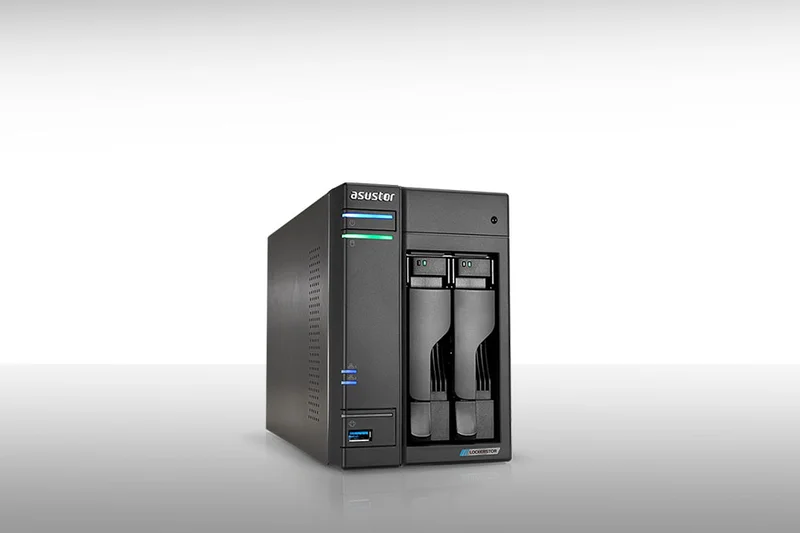
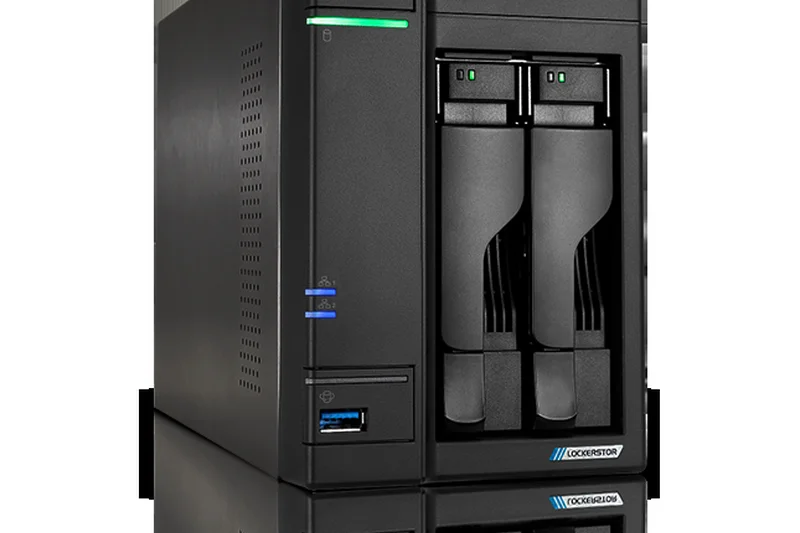
Why we picked it: A more professional alternative to the Nimbustor, the Lockerstor 2 Gen2 features a clean metal chassis while retaining the excellent Intel Celeron N5105 CPU, dual 2.5GbE ports, and four M.2 NVMe slots. It represents an excellent balance of business-class aesthetics and high-speed local performance, perfect for a small office needing reliable file sharing and robust caching.
Key Specs
- Intel Celeron N5105 Quad-Core CPU
- 4GB DDR4 RAM
- Dual 2.5GbE Ports
- 4x M.2 NVMe SSD Slots
- HDMI 2.0b Output
What we like
- Professional metal chassis
- Four M.2 NVMe slots allow extensive caching
- Reliable dual 2.5GbE networking
What we don't like
- Base 4GB RAM is a bit low for heavy multitasking
- Limited to 2 primary bays
Best for: Professional users needing a compact, fast 2-bay NAS with business-appropriate styling.
Identical under the hood to the Nimbustor 2, but wrapped in a durable, professional-looking metal case.
A rugged, high-performing 2-bay NAS tailored for small business environments.
Check price at Amazon#21 Synology DiskStation DS725+
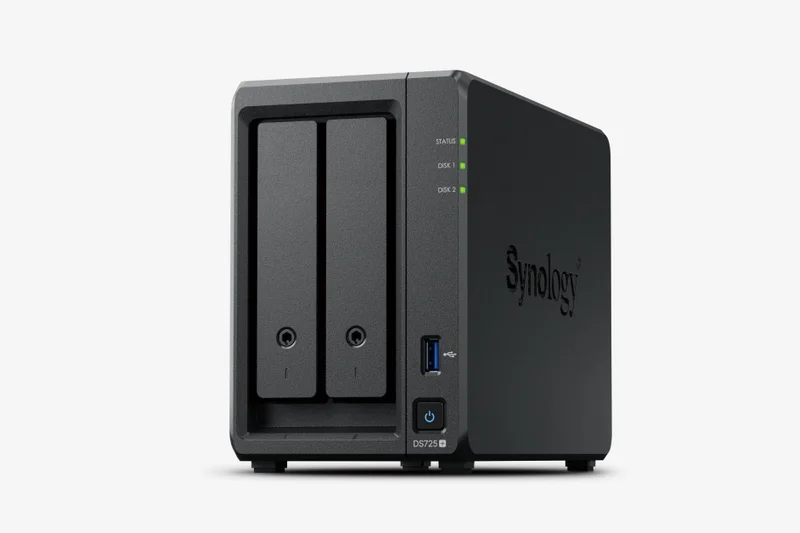
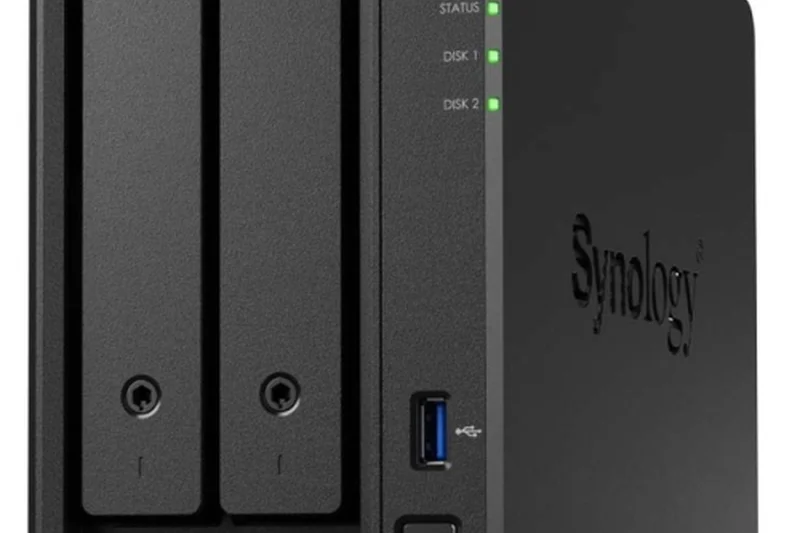
Why we picked it: The newly released Synology DS725+ refines the premium 2-bay category. While it sticks to dual 1GbE ports, its updated Intel Celeron CPU and Btrfs file system support provide an exceptionally reliable platform for Synology's Active Backup for Business. It is incredibly quiet, power-efficient, and easily handles automated backups and file syncing for remote workers.
Key Specs
- Intel Celeron Quad-Core CPU
- 2GB DDR4 RAM
- Dual 1GbE Ports
- M.2 NVMe SSD Caching Slots
- Btrfs file system capabilities
What we like
- Stellar Synology DSM software
- Btrfs support for data snapshotting
- Very quiet and energy efficient
What we don't like
- Only 1GbE networking is disappointing for 2026
- 2GB RAM is restrictive for VMs
Best for: Remote workers needing bulletproof automated backups via an intuitive interface.
Competitors offer 2.5GbE at this price, but Synology's software polish and stability remain unmatched.
The quintessential 2-bay NAS for automated home office backups, despite its conservative hardware.
Check price at Amazon#22 Dell PowerEdge R250 Rack Server
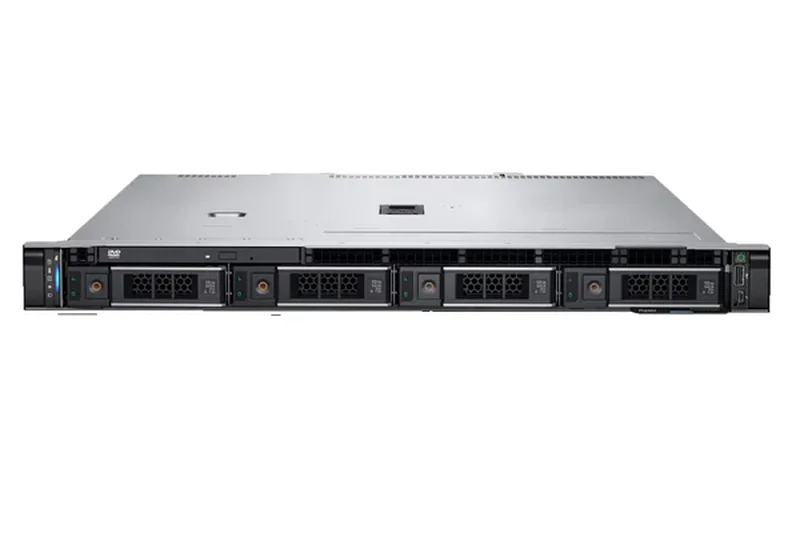
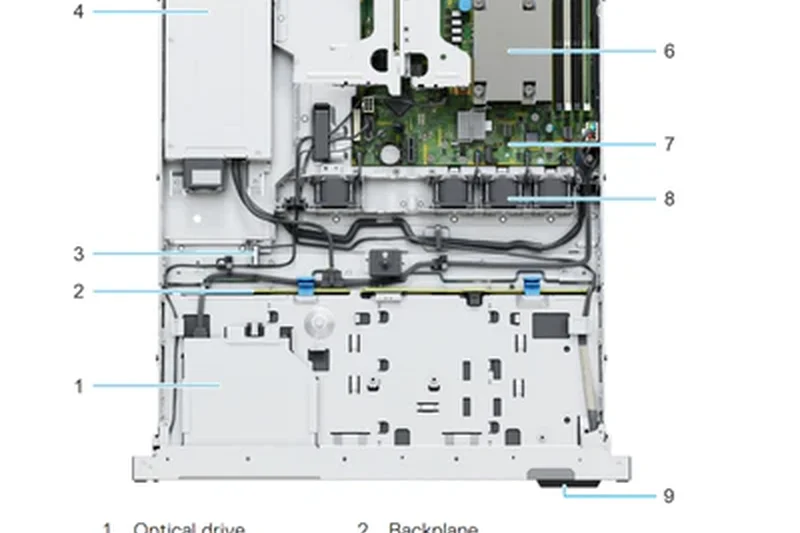
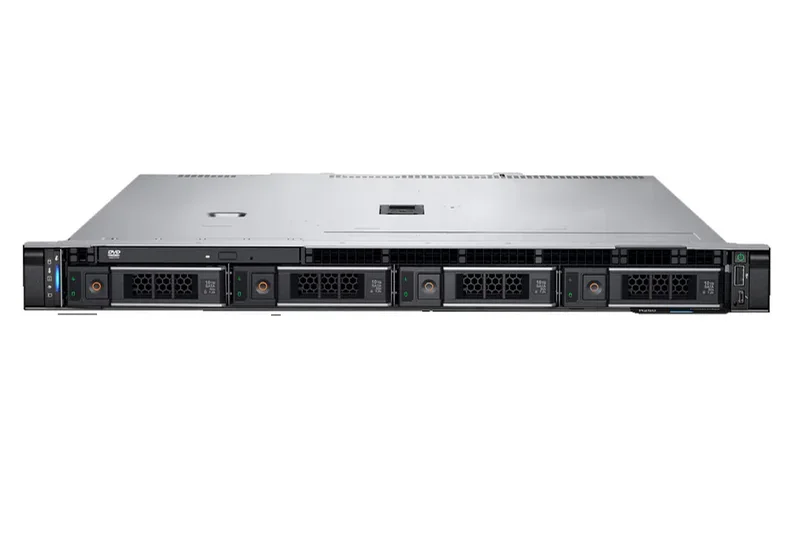
Why we picked it: For home offices equipped with a server rack, the Dell PowerEdge R250 is an excellent entry-level 1U server. Powered by a Xeon E-2300 series processor and ECC memory, it provides robust enterprise infrastructure. Features like hot-plug HDDs and iDRAC9 Datacenter management make it a highly resilient machine, though its 1U fans will generate noticeable noise under load.
Key Specs
- Intel Xeon E-2300 Series CPU
- Up to 128GB DDR4 ECC RAM
- 4x 3.5-inch Hot-Plug HDDs
- Dual 1GbE Network Ports
- iDRAC9 Datacenter Remote Management
What we like
- Hot-plug drive bays
- Superb iDRAC9 remote administration
- High memory capacity (128GB)
What we don't like
- 1U form factor is noisy
- Requires a server rack for proper mounting
Best for: Advanced home lab users and IT consultants with dedicated, sound-isolated rack space.
Compared to tower servers, the R250 is denser but louder, intended for proper rack deployment.
A true 1U enterprise server that delivers Dell's renowned reliability to the home data center.
Buy at Dell official site#23 UnifyDrive UT2
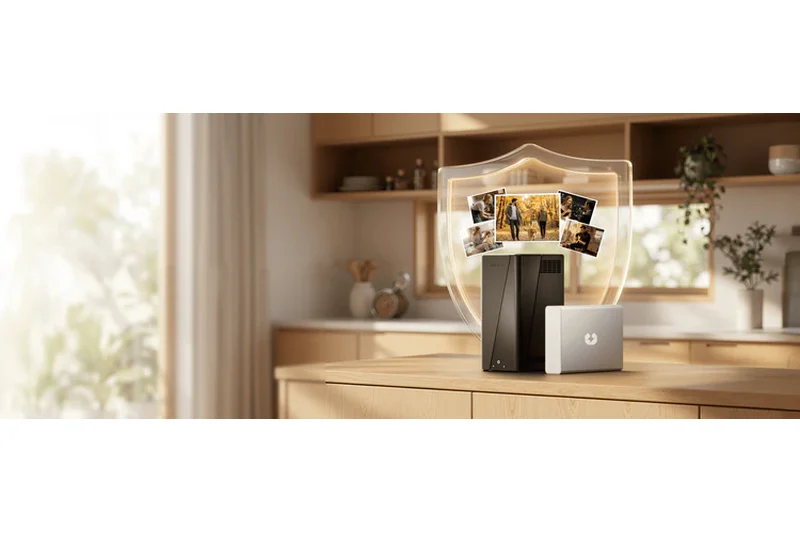

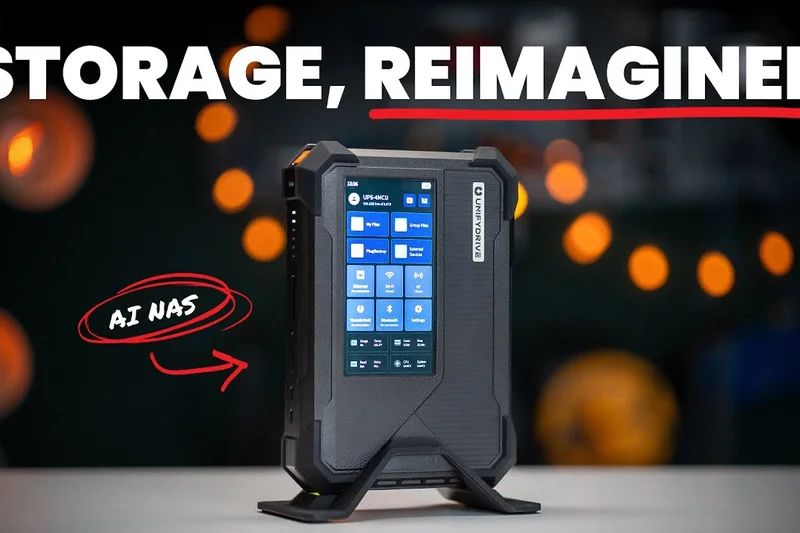
Why we picked it: The UnifyDrive UT2 is a brilliant portable NAS designed for content creators on the move. Pocket-sized but powerful, it supports up to 8TB of dual NVMe storage. With built-in Wi-Fi 6, a 2.5GbE port, and direct SD/CFexpress card readers, you can back up footage in the field and sync it to your home office automatically. It also acts as a media player via HDMI.
Key Specs
- Pocket-sized Portable Design
- Dual M.2 slot up to 8TB NVMe SSD Support
- Built-in Wi-Fi 6 & 2.5GbE Ethernet
- SD Card & CFexpress Card Reader
- Direct HDMI to TV out
What we like
- Incredibly portable design
- Direct card readers for instant media backups
- Wi-Fi 6 and 2.5GbE connectivity
What we don't like
- Not designed for 24/7 multi-user office loads
- Software is basic compared to desktop NAS
Best for: Traveling photographers and videographers who need mobile, secure storage that integrates with their home office.
Unlike stationary NAS devices, the UT2 is designed to travel in your camera bag and sync when you return.
An innovative, highly portable NVMe NAS tailored specifically for mobile content creators.
Check price at Amazon#24 UGREEN NASync DXP2800
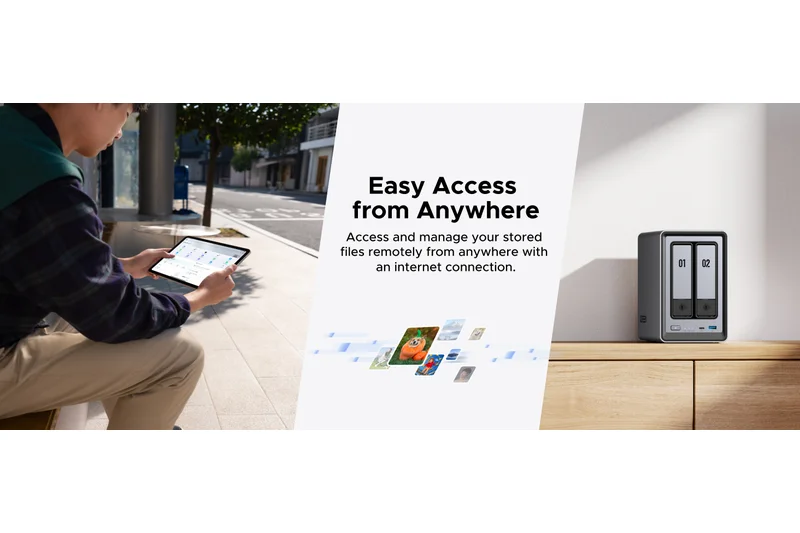
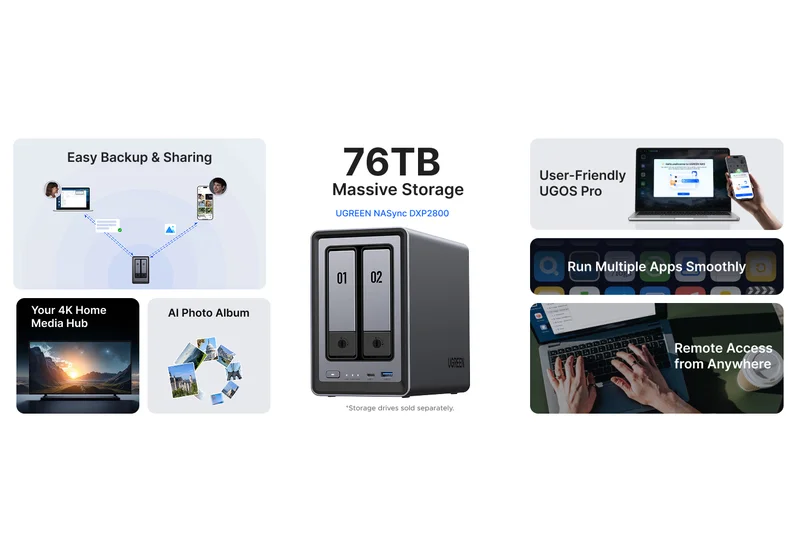
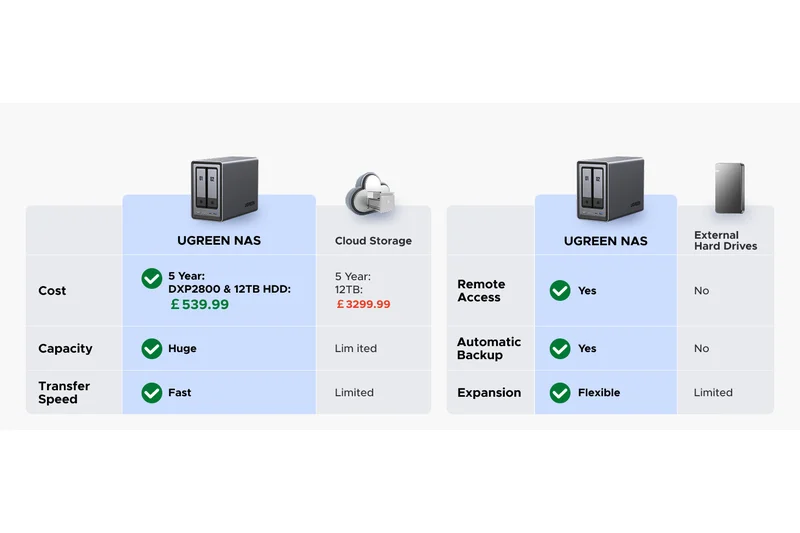
Why we picked it: The UGREEN NASync DXP2800 offers high-end build quality in a 2-bay form factor. Using the efficient Intel N100 Quad-Core CPU and a generous 8GB of DDR5 RAM, it provides snappy performance for daily file sharing and Docker containers. The 2.5GbE port and dual NVMe slots offer excellent bandwidth and caching capabilities at a very reasonable price point.
Key Specs
- Intel N100 Quad-Core CPU
- 8GB DDR5 RAM
- 1x 2.5GbE Port
- 2x HDD Bays + 2x M.2 NVMe Slots
- Premium Aluminum Alloy Chassis
What we like
- 8GB DDR5 RAM is excellent for a 2-bay NAS
- Beautiful, premium aluminum construction
- Power-efficient Intel N100 processor
What we don't like
- App ecosystem is still a work in progress
- Only a single 2.5GbE port
Best for: Design-conscious users wanting a powerful, good-looking 2-bay NAS for their desk.
Out-specs entry-level Synology models significantly, though lacks the same level of software refinement.
A beautifully crafted 2-bay NAS offering strong hardware value and efficiency.
Buy at UGREEN official site#25 QNAP TS-216G
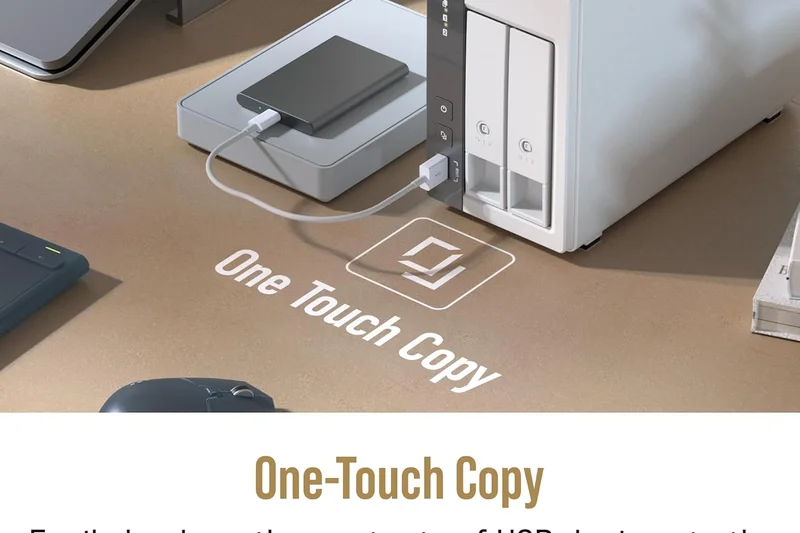
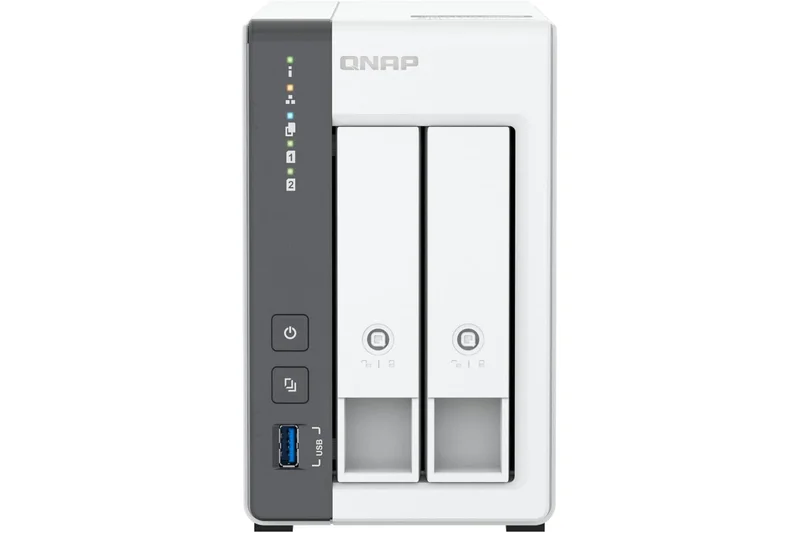
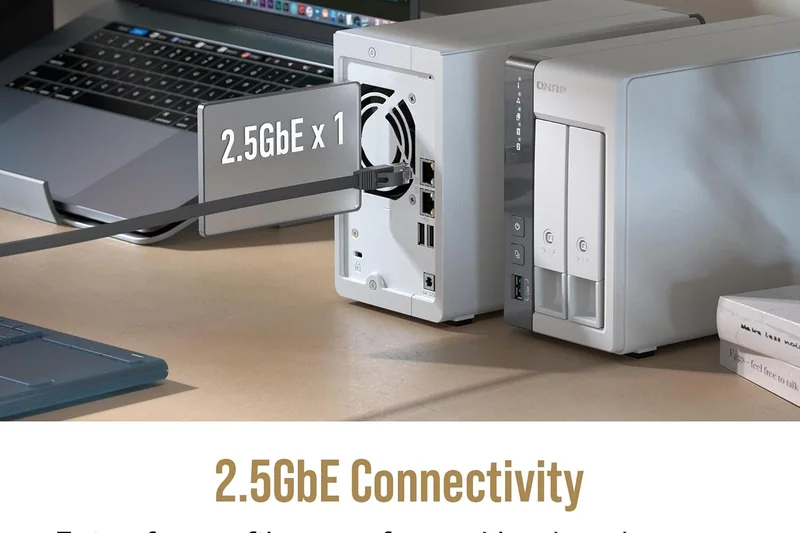
Why we picked it: The QNAP TS-216G is an AI-enhanced 2-bay NAS tailored for intelligent file and photo management. Its ARM Cortex-A55 CPU features a built-in NPU (Neural Processing Unit) that drastically speeds up facial and object recognition in QNAP's QuMagie app. It includes a 2.5GbE port for fast transfers and a convenient front-facing USB copy button for quick external drive backups.
Key Specs
- ARM Cortex-A55 Quad-Core 2.0GHz CPU
- 4GB RAM
- 1x 2.5GbE & 1x 1GbE Ports
- NPU built-in for AI computing
- Front-facing USB Copy Button
What we like
- Dedicated NPU accelerates AI photo sorting
- Includes 2.5GbE networking
- Excellent price-to-feature ratio
What we don't like
- ARM processor limits virtualization capabilities
- Plastic chassis
Best for: Home users and photographers looking for an affordable NAS with fast AI photo management.
The NPU gives it a massive advantage over standard ARM-based NAS units when organizing large photo libraries.
An affordable, smart 2-bay NAS that excels at photo indexing and fast local transfers.
Buy at QNAP official site#26 Lenovo ThinkSystem ST50 V2
Why we picked it: The Lenovo ThinkSystem ST50 V2 is a whisper-quiet, entry-level tower server designed specifically for small offices. It utilizes an Intel Xeon E-2300 CPU and ECC RAM, providing server-grade reliability without data center noise. While it only supports three 3.5-inch drives and lacks out-of-band management, its Intel VROC software RAID and solid construction make it an excellent basic Windows Server host.
Key Specs
- Intel Xeon E-2300 Series CPU
- Up to 64GB DDR4 ECC RAM
- 3x 3.5-inch Drive Bays
- 1x Gigabit Ethernet
- Intel VROC Software RAID
What we like
- Extremely quiet operation suitable for desksides
- Xeon CPU with ECC memory support
- Very reliable enterprise-grade hardware
What we don't like
- Lacks advanced remote management (no XCC/iLO)
- Limited to 3 drives
Best for: Small offices needing a quiet, reliable entry-level server for basic domain control and file sharing.
Quieter than the Dell T150, but sacrifices advanced remote management capabilities.
A highly dependable, near-silent mini-tower perfect for basic small business workloads.
Buy at Lenovo official site#27 ZimaBlade
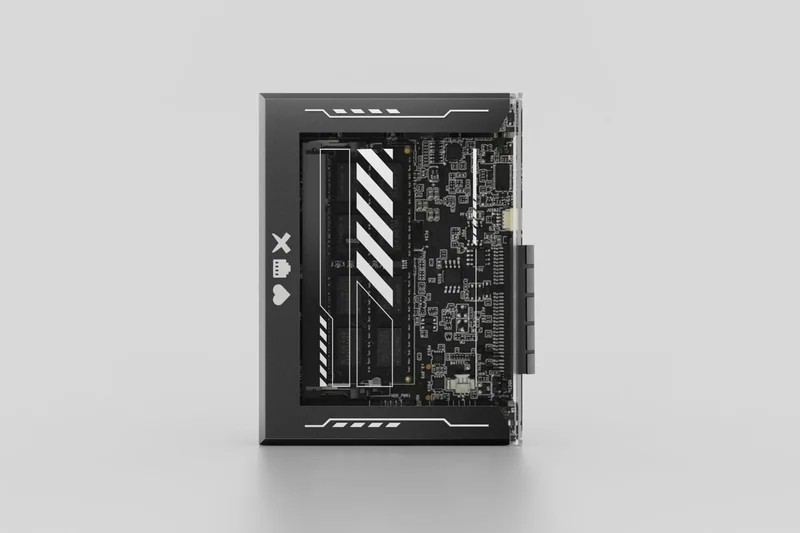
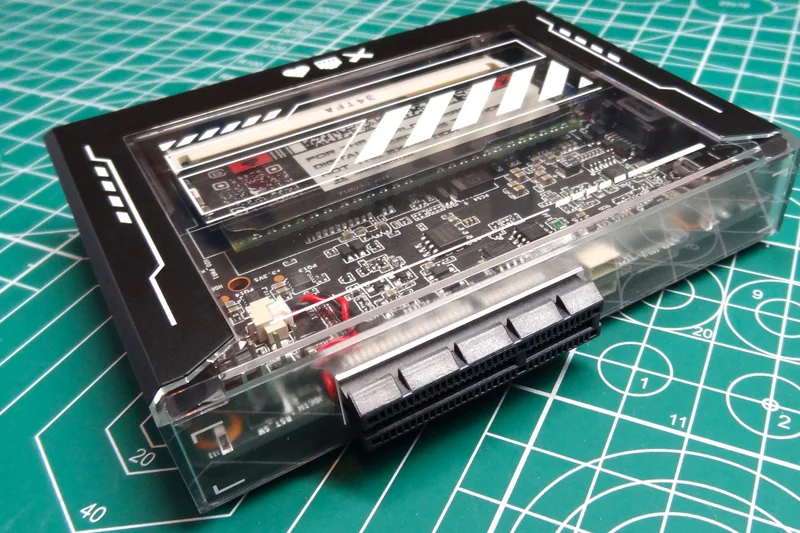
Why we picked it: Taking our 'Best Value' award, the ZimaBlade is a radically affordable, single-board micro server. Costing just $69, it provides an Intel Celeron CPU, a PCIe Gen 3.0 slot, and dual SATA ports. Designed for absolute minimalists and edge-computing enthusiasts, you can attach your own drives and RAM to run lightweight Docker containers or a retro-gaming server at virtually zero power cost.
Key Specs
- Intel Celeron Dual-Core CPU
- 1x SODIMM RAM Slot (supports up to 16GB)
- 1x PCIe Gen 3.0 x4 Slot
- 1x Gigabit Ethernet
- Dual SATA 3.0 Ports
What we like
- Incredible $69 entry price
- PCIe slot allows for network or storage expansion
- Extremely low power consumption
What we don't like
- Requires external drive enclosures/power
- Dual-core CPU is easily overwhelmed
Best for: Hobbyists, tinkerers, and students wanting to build an ultra-cheap micro server.
It’s a DIY builder's board rather than a turnkey NAS, competing more with Raspberry Pis than Synology.
A brilliantly designed, hackable micro server that offers unbeatable value for DIY tech enthusiasts.
Buy at Zima official site#28 Asustor Drivestor 4 Gen2 AS1204T
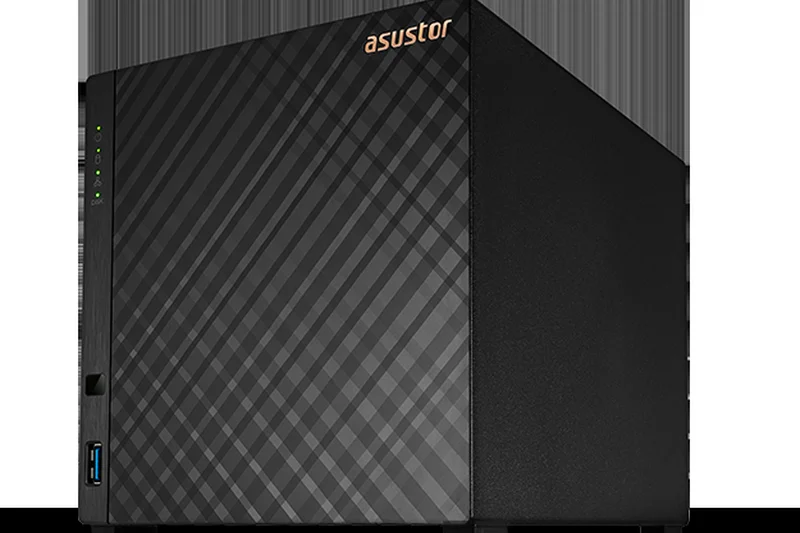
Why we picked it: The Asustor Drivestor 4 Gen2 offers an incredibly affordable way to achieve 4-bay storage. Utilizing a Realtek Quad-Core CPU and 1GB of RAM, it isn't meant for heavy apps, but it natively supports the Btrfs file system for snapshot protection. The inclusion of a 2.5GbE port makes it an excellent, fast repository for bulk backups without breaking the bank.
Key Specs
- Realtek RTD1619B Quad-Core CPU
- 1GB DDR4 RAM
- 1x 2.5GbE Port
- Btrfs file system support for snapshots
- Toolless drive caddies
What we like
- Very affordable for a 4-bay NAS
- 2.5GbE networking included
- Btrfs support for ransomware protection
What we don't like
- 1GB RAM limits app usage severely
- CPU is strictly for basic file sharing
Best for: Budget-conscious users who simply need a fast, 4-drive backup target.
It lacks the multimedia grunt of higher-end Asustor models, but delivers 2.5GbE speeds for basic file transfers.
A barebones, budget-friendly 4-bay NAS that nails the basics of fast, secure file sharing.
Check price at Amazon#29 Synology DiskStation DS223j
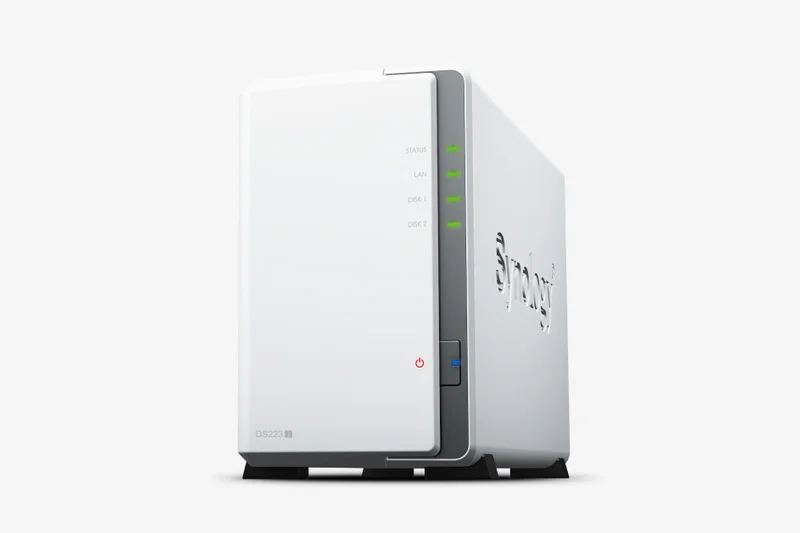
Why we picked it: The DS223j is Synology's entry-level 2-bay NAS, designed to be as simple and unintimidating as possible. Running the acclaimed DSM software, it allows anyone to set up a personal cloud, sync files across devices, and back up photos automatically. It now supports Btrfs, adding a layer of data protection previously reserved for more expensive models.
Key Specs
- Realtek RTD1619B Quad-Core CPU
- 1GB DDR4 RAM
- 2x 3.5/2.5-inch Drive Bays
- 1x 1GbE Port
- Btrfs file system support
What we like
- Extremely affordable entry into the Synology ecosystem
- Btrfs support for data snapshots
- Silent and power-efficient
What we don't like
- Sluggish performance in the web GUI
- 1GbE networking limits transfer speeds
Best for: Home users wanting a cheap, reliable personal cloud for document and photo backups.
While Asustor offers faster hardware at this price, the DS223j provides the unmatched simplicity of Synology DSM.
A quiet, highly reliable personal cloud device perfect for basic home office backups.
Buy at Synology official site#30 QNAP TS-233
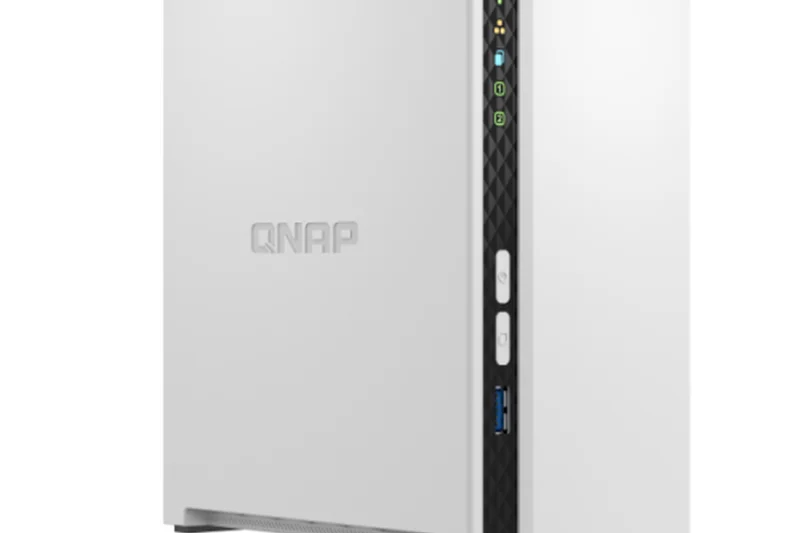
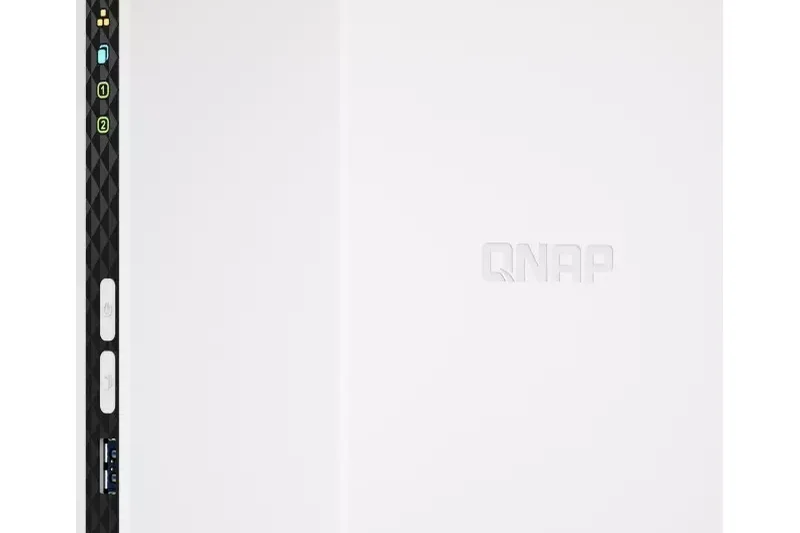
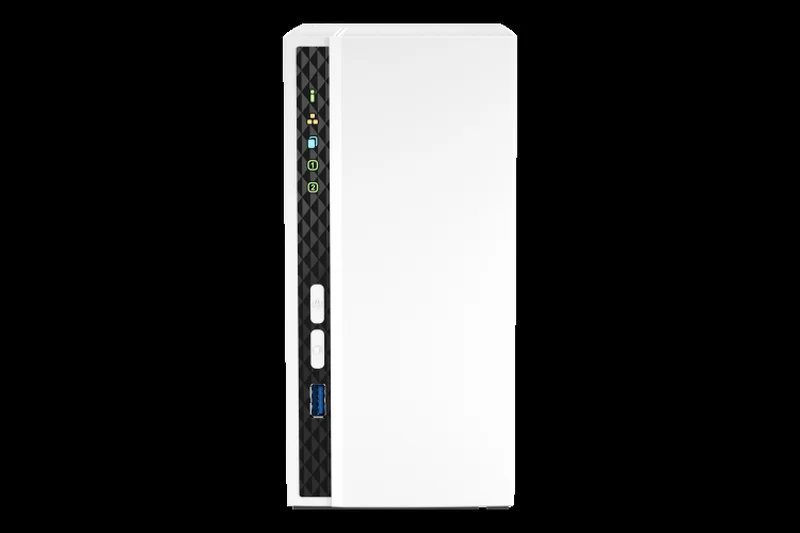
Why we picked it: The QNAP TS-233 is a sleek, white 2-bay NAS that blends well into modern home decors. It features an ARM Cortex-A55 processor equipped with an NPU for AI image recognition, making it surprisingly adept at organizing family photos. The toolless design and 2GB of RAM provide a slightly smoother experience than the absolute base-tier models.
Key Specs
- ARM Cortex-A55 Quad-Core 2.0GHz CPU
- 2GB DDR4 RAM
- 1x 1GbE Port
- NPU for AI Image Recognition
- Toolless drive installation
What we like
- Clean, attractive aesthetic
- NPU speeds up photo indexing
- Toolless drive installation
What we don't like
- Only 1GbE networking
- Not suited for video transcoding or VMs
Best for: Home users looking for an aesthetically pleasing, photo-centric personal backup drive.
A direct competitor to the DS223j, offering slightly more RAM and an NPU for better photo management.
A smart, attractive 2-bay NAS designed for simple file sharing and AI-powered photo organization.
Buy at QNAP official site#31 Asustor Drivestor 2 AS1102T
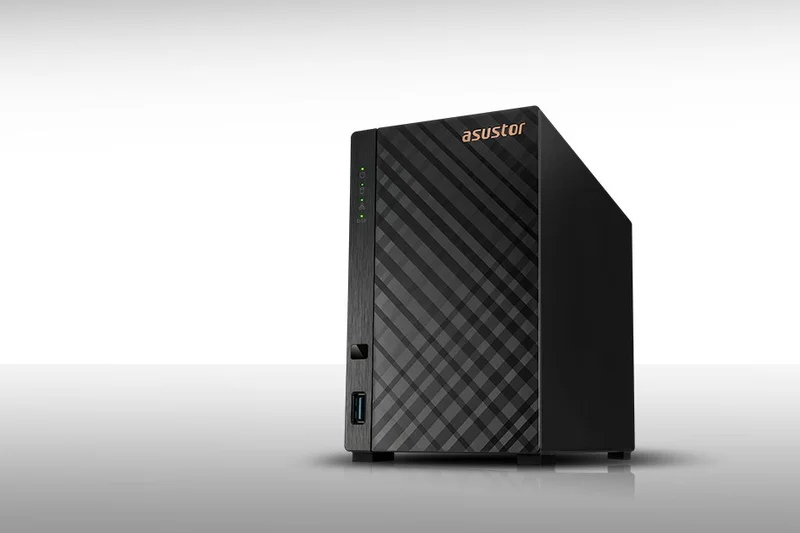
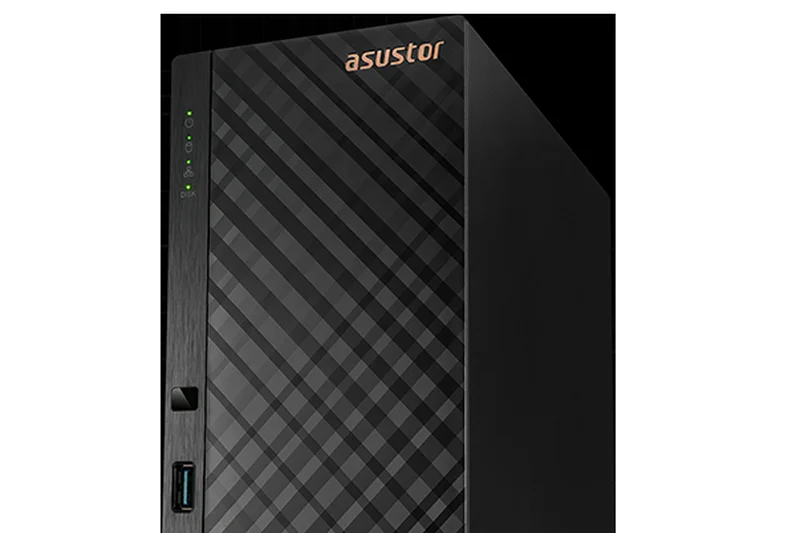
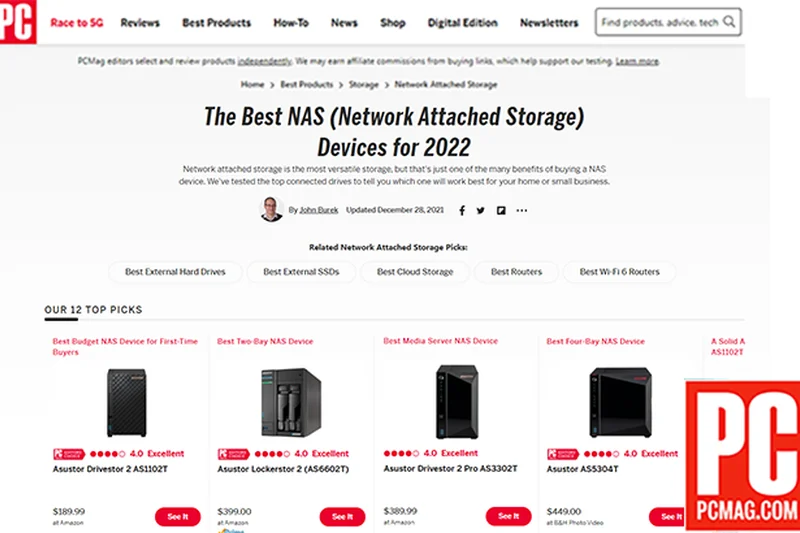
Why we picked it: The AS1102T remains a solid ultra-budget 2-bay option. It stands out by offering 2.5GbE networking at a price point where most competitors only offer 1GbE. It supports 4K H.265 hardware transcoding, making it an excellent, low-cost Plex media server for home use, even if its 1GB of RAM limits multitasking.
Key Specs
- Realtek RTD1296 Quad-Core CPU
- 1GB DDR4 RAM
- 1x 2.5GbE Port
- Toolless design with thumb screws
- 4K H.265 Hardware Transcoding
What we like
- Incredible value with 2.5GbE included
- Hardware video transcoding support
- Toolless installation
What we don't like
- Older CPU architecture
- 1GB RAM severely limits application use
Best for: Budget users wanting to set up an affordable, fast Plex server.
Beats entry-level Synology models in raw network bandwidth and video transcoding capabilities.
An ultra-budget 2-bay NAS that surprisingly delivers 2.5GbE and video transcoding.
Check price at Amazon#32 TerraMaster F2-221
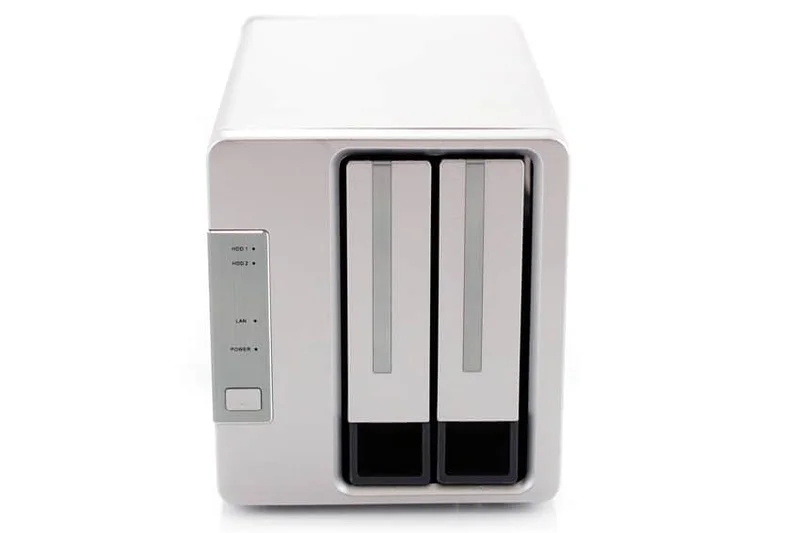
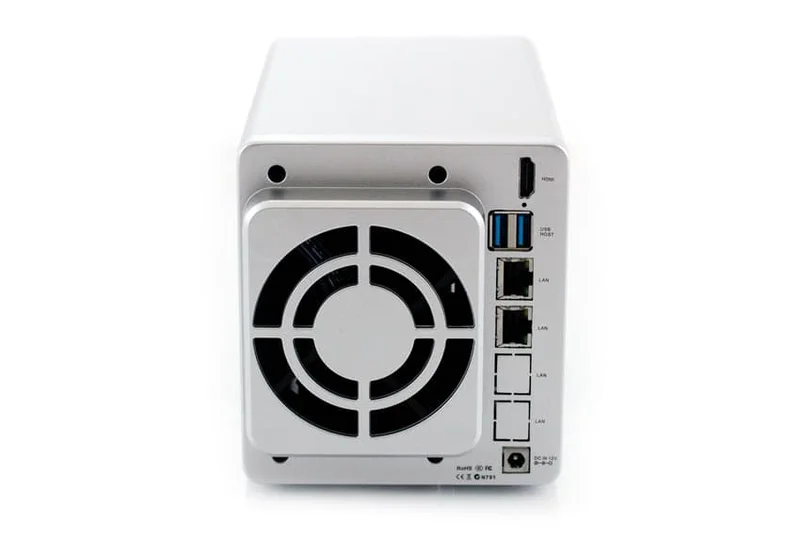
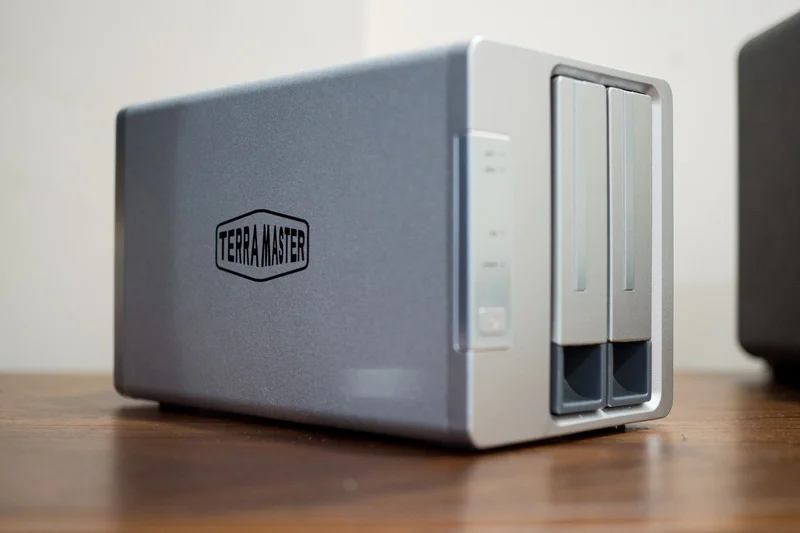
Why we picked it: Though an older model, the TerraMaster F2-221’s Intel Celeron CPU and aluminum shell still provide decent value. With dual 1GbE ports and expandable RAM, it’s a rugged little 2-bay NAS for users who need a sturdy enclosure for basic data redundancy and 4K video transcoding.
Key Specs
- Intel Celeron J3355 Dual-Core CPU
- 2GB RAM (expandable to 6GB)
- Dual 1GbE Ports
- Aluminum alloy shell structure
- 4K Video Transcoding support
What we like
- Solid aluminum build quality
- RAM is expandable
- Intel CPU supports hardware transcoding
What we don't like
- Aging dual-core processor
- Outdated compared to current 2.5GbE models
Best for: Buyers looking for a durable, metallic 2-bay NAS at a clearance or discounted price.
It lacks modern 2.5GbE speeds but offers a sturdier build than most plastic entry-level units.
A legacy 2-bay NAS that remains a viable budget option due to its solid construction and Intel CPU.
Check price at Amazon#33 Synology BeeStation Plus 8TB
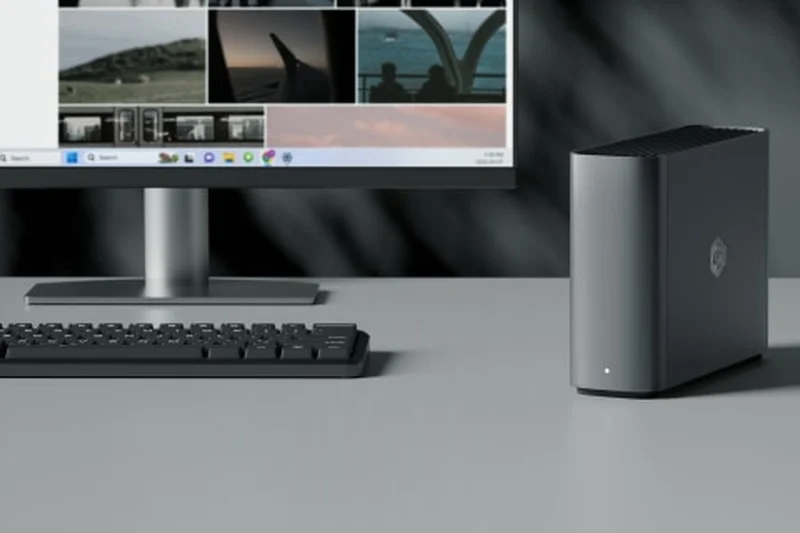
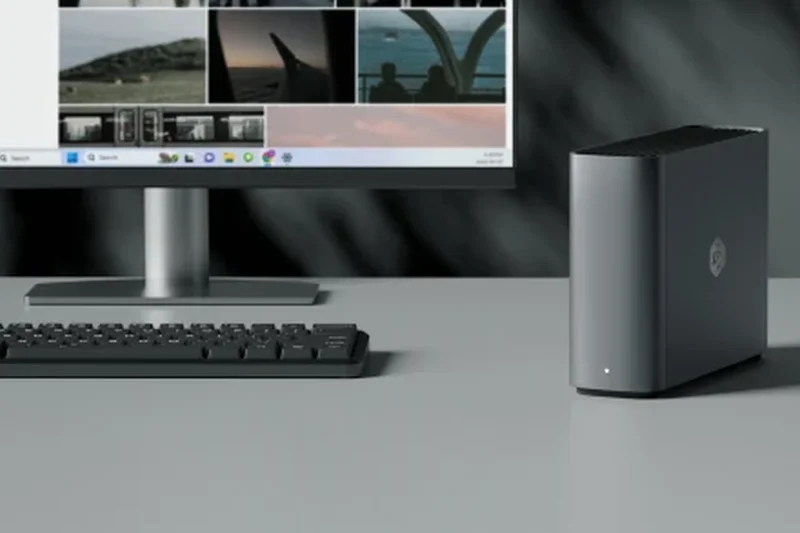
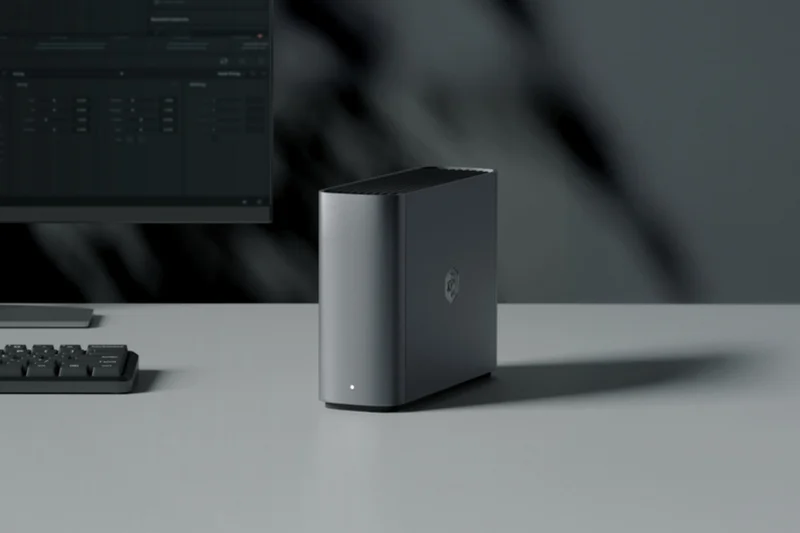
Why we picked it: The BeeStation Plus 8TB is a radical departure from traditional NAS devices; it is a turnkey "Personal Cloud" appliance. Pre-populated with an 8TB drive, it requires zero configuration. You simply plug it in, scan a QR code, and you immediately have a private alternative to Google Drive or iCloud. The BeeFiles and BeePhotos apps are incredibly intuitive for non-technical users.
Key Specs
- Pre-installed 8TB Storage
- 1x 1GbE LAN Port
- USB-A and USB-C Transfer Ports
- Zero-configuration setup
- Synology BeeFiles & BeePhotos apps
What we like
- Zero setup required; truly plug-and-play
- No monthly cloud subscription fees
- Excellent mobile apps
What we don't like
- No RAID redundancy (single drive)
- Lacks the advanced features of a true NAS
Best for: Non-technical users who want the convenience of cloud storage without paying monthly fees.
It trades the redundancy and flexibility of a DiskStation for absolute plug-and-play simplicity.
The ultimate set-it-and-forget-it personal cloud drive for consumers terrified of IT setups.
Buy at Synology official site#34 Synology BeeStation BST150-4T
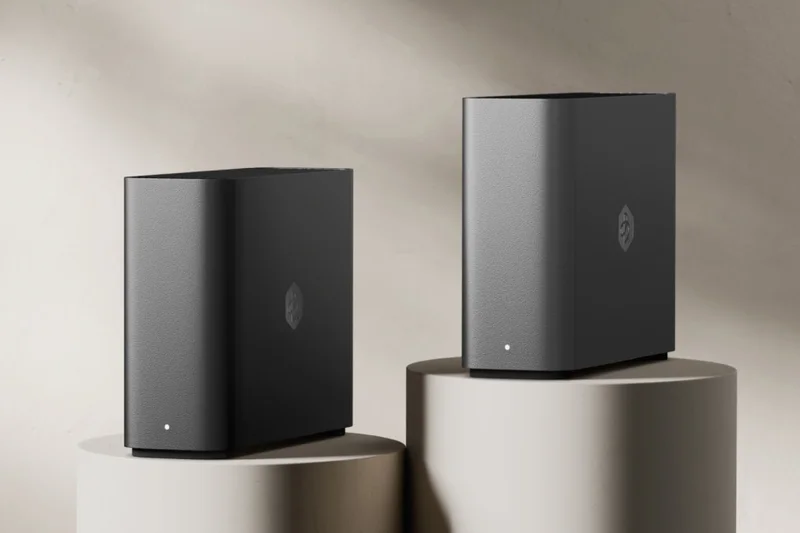

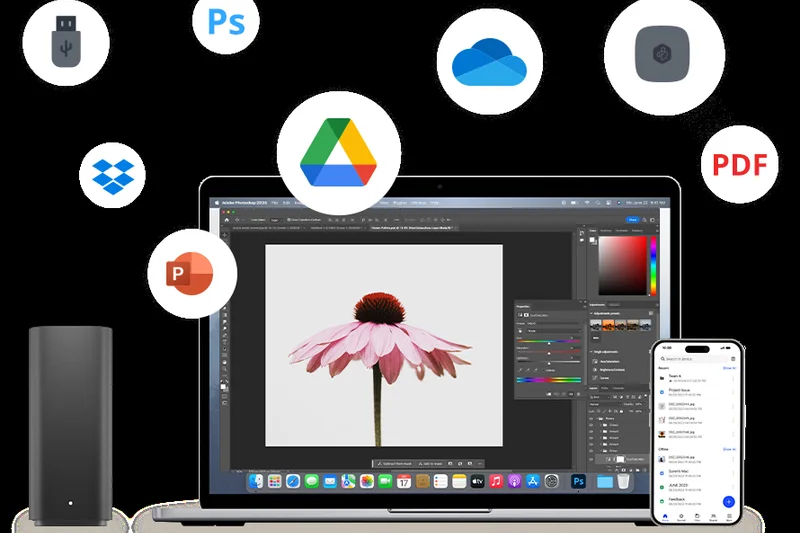
Why we picked it: Similar to the Plus model, the BeeStation BST150-4T is a pre-configured 4TB personal cloud device. It offers the exact same seamless QR-code setup and excellent mobile apps for photo backup and file sharing, but at a more accessible $219 price point. It’s perfect for casual users looking to reclaim their smartphone storage.
Key Specs
- Realtek RTD1619B Quad-Core CPU
- 1GB DDR4 RAM
- Pre-installed 4TB HDD
- 1x 1GbE Port
- Built-in AI Photo Management
What we like
- Very affordable out-of-the-box solution
- Perfect alternative to paid cloud tiers
- Great AI photo management
What we don't like
- Single point of failure (no drive redundancy)
- Storage cannot be upgraded internally
Best for: Individuals needing an immediate, cheap solution to smartphone storage limits.
A smaller, cheaper version of the 8TB BeeStation, offering identical ease-of-use.
A highly accessible, ready-to-use 4TB personal cloud that completely eliminates setup friction.
Buy at Synology official site#35 LatticeWork Amber X
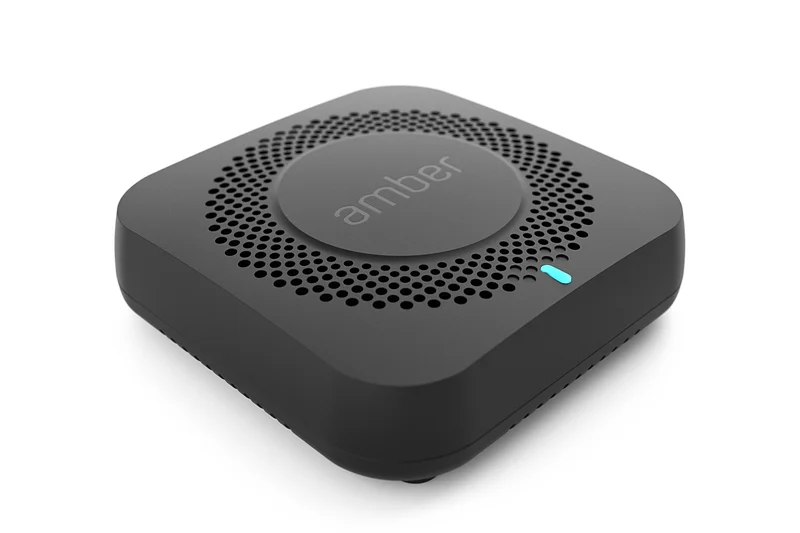
Why we picked it: The LatticeWork Amber X is a unique personal cloud device built around a 512GB internal SSD. It features built-in Wi-Fi and Bluetooth, meaning it doesn't even need to be plugged directly into a router. Its AI photo organizer software operates completely offline, ensuring absolute privacy. While capacity is low, you can expand it via USB or SD cards.
Key Specs
- 512GB Built-in SSD Storage
- SD Card Slot & USB port for capacity expansion
- 1x Gigabit Ethernet
- Built-in Wi-Fi & Bluetooth
- AI Photo Organizer software
What we like
- Wireless connectivity allows placement anywhere
- Fast internal SSD storage
- Strong focus on offline data privacy
What we don't like
- 512GB is very small for the price
- Requires external drives for meaningful capacity
Best for: Privacy-focused users wanting a small, wireless, SSD-based photo vault.
Unlike the BeeStation, it offers wireless connectivity and SSD speed, but at the cost of significantly less storage.
A niche but well-executed wireless SSD vault for users prioritizing offline AI sorting and privacy.
Check price at AmazonBuying Guide
How to Choose the Right Home Office Server
Selecting a home office server is fundamentally different from outfitting an enterprise server room. You are balancing the need for data redundancy, remote accessibility, and processing power against constraints like physical space, fan noise, and upfront costs. Here is how to navigate the current server landscape.
Understand Your User Profile
The Hybrid Worker & Small Business Owner: If your primary goal is centralizing files, running automated backups for local PCs, and hosting lightweight applications, a 2-bay or 4-bay desktop NAS is usually sufficient. Look for devices with 2.5GbE networking and intuitive software ecosystems like Synology DSM or Asustor ADM. You want a system that practically manages itself without requiring command-line intervention.
The Content Creator & Media Professional: Video editors and designers face massive file sizes that can cripple standard networks. If you edit 4K or 8K video directly from the server, raw CPU power is less important than network bandwidth and drive speed. Prioritize 10GbE or Thunderbolt 4 connectivity, NVMe SSD caching slots, and a minimum of four to six drive bays to accommodate large, high-throughput RAID arrays.
The Home Lab Enthusiast & Developer: If you plan to run multiple virtual machines, Docker containers, or test enterprise software, compute performance and memory are your bottlenecks. You need a device with a modern x86 CPU (Intel Core i3/i5 or AMD Ryzen), substantial RAM expandability (up to 64GB or 128GB), and support for advanced hypervisors or ZFS file systems. Compact tower servers or high-end NAS devices fit this bill perfectly.
Key Features to Look For in 2026
- Multi-Gigabit Networking: Do not buy a server in 2026 that only has 1GbE ports unless your budget is strictly under $250. 2.5GbE is the new standard, and 10GbE is becoming highly affordable.
- M.2 NVMe Slots: Mechanical hard drives are great for bulk storage, but they are slow. Modern servers use M.2 NVMe SSD slots either as a fast storage pool for active projects or as a cache to accelerate HDD read/write speeds.
- ECC Memory: Error-Correcting Code (ECC) RAM prevents data corruption in memory before it is written to your drives. If you are storing critical business data or using the advanced ZFS file system, ECC memory is highly recommended.
What to Avoid
Beware of vendor lock-in. Some manufacturers increasingly require you to buy their branded (and heavily marked-up) hard drives or RAM to receive full technical support. Always check the compatibility list and community forums to ensure you can use standard, off-the-shelf components. Additionally, avoid high-RPM rackmount servers unless you have a dedicated, soundproofed closet. 1U and 2U rack servers often use small, high-speed fans that sound like jet engines—highly disruptive and distracting in a standard home office environment.
Budget Tiers
Under $400 (Entry-Level): Expect 2-bay NAS devices or micro PCs like the ZimaBlade. You will get reliable file sharing, basic backups, and low power consumption. Perfect for solo freelancers.
$400 to $900 (Mid-Range): The sweet spot for most home offices. You will find powerful 4-bay NAS devices and compact towers with 2.5GbE networking, NVMe caching, and enough CPU power for media transcoding or light virtualization tasks.
$1,000+ (High-End): Aimed at power users, media pros, and serious home labs. These systems feature 6 to 12 bays, 10GbE or USB4 networking, desktop-class processors, and extensive upgrade paths for memory and PCIe add-in cards.
FAQ
What is the difference between a NAS and a traditional server?
A NAS (Network Attached Storage) is a specialized server optimized specifically for data storage, file sharing, and backups, usually running a custom, easy-to-use operating system. A traditional server (like a Dell PowerEdge) is a general-purpose machine that requires you to install a server OS (like Windows Server) and is designed for heavy compute tasks, domain management, and extensive virtualization.
Do I really need 2.5GbE or 10GbE in my home office?
If you frequently move large files, such as 4K video projects, massive RAW photo batches, or full PC image backups, standard 1GbE (which maxes out around 110-125 MB/s) will cause significant bottlenecks. 2.5GbE provides speeds over 280 MB/s, and 10GbE allows speeds upwards of 1,000 MB/s, matching the speed of internal SSDs.
What is ECC memory and why is it recommended?
ECC (Error-Correcting Code) RAM detects and corrects single-bit memory errors on the fly. This prevents 'bit rot' and silent data corruption. If you are storing critical business files, client data, or using an advanced file system like ZFS, ECC memory is highly recommended for long-term data integrity.
How many drive bays do I need?
A 2-bay NAS is sufficient for basic RAID 1 (mirroring), meaning if one drive fails, your data is safe. A 4-bay or 6-bay NAS allows for RAID 5 or RAID 6, which provides a much better balance of storage capacity, read speed, and redundancy. We generally recommend 4-bay models for the best long-term flexibility.
Can I use standard hard drives in a home office server?
You should use drives specifically designed for NAS or Enterprise environments (like WD Red Plus/Pro or Seagate IronWolf). These drives are engineered to withstand the 24/7 rotational vibration and heat of a multi-drive chassis. Avoid cheap 'SMR' (Shingled Magnetic Recording) desktop drives, as they perform terribly in RAID arrays.
Are M.2 NVMe slots necessary on a NAS?
While not strictly necessary, M.2 NVMe slots are highly beneficial. They can be used as a high-speed read/write cache to accelerate slower mechanical hard drives, or as a dedicated flash storage pool for running virtual machines and databases with zero latency.
What is the 'M2 Multi-Dimensional Evaluation' methodology?
It is a systematic decision-making framework from Selection Logic. It evaluates products across multiple distinct dimensions (like Performance, Storage, and Value) and applies specific weights based on user needs, calculating a 'Fit Score' to ensure you buy hardware that matches your actual use case rather than just buying the most expensive option.
How loud are these servers under load?
Compact NAS devices and micro servers are generally very quiet, emitting around 20-30 dB, making them suitable to sit directly on a desk. Rackmount servers (like 1U/2U designs) use small, high-speed fans that can exceed 50-60 dB, requiring them to be placed in an isolated room or soundproof rack.
Can a home office server run virtual machines?
Yes, provided it has an x86 processor (Intel or AMD) and sufficient RAM. Devices powered by Intel Celeron or basic ARM chips struggle with VMs. For smooth virtualization, look for a server with an Intel Core i3/i5 or AMD Ryzen CPU and at least 16GB of RAM.
What is the difference between Btrfs and ZFS file systems?
Both are advanced file systems offering data protection. Btrfs is highly flexible, allowing you to mix and match drive sizes easily (common in Synology devices). ZFS is an enterprise-grade file system (used in TrueNAS and high-end QNAP models) offering superior data integrity and caching, but requires more RAM and stricter drive configurations.
Is a NAS a replacement for cloud backups?
No. A NAS protects you against local hardware failure (via RAID), but it does not protect against fire, theft, or catastrophic flooding. You should follow the 3-2-1 backup rule: keep 3 copies of your data, on 2 different media types, with 1 copy offsite (in the cloud or at a remote NAS).
What is out-of-band management (iLO/iDRAC)?
Out-of-band management is a dedicated hardware chip on enterprise servers that allows you to remotely access the server's BIOS, view the screen, and power cycle the machine even if the operating system has completely crashed. It is invaluable for remote IT administration.
Should I buy an all-flash NAS?
If your priority is zero noise, minimal physical footprint, and extreme transfer speeds (like for 4K video editing), an all-flash NAS (using only SSDs) is fantastic. However, the cost-per-terabyte is significantly higher than using mechanical hard drives.
Can I upgrade the CPU in my NAS?
In most consumer and prosumer NAS devices (Synology, QNAP, Asustor), the CPU is soldered to the motherboard and cannot be upgraded. You can usually only upgrade the RAM and PCIe expansion cards. Traditional tower servers (like Dell or HPE) often allow CPU upgrades within the same socket generation.
How long should a home office server last?
A quality server should easily last 5 to 7 years in a home office environment. While the hard drives may need replacing every 4-5 years due to mechanical wear, the core chassis, CPU, and RAM can provide reliable service long after the manufacturer warranty expires.
Methodology
Our evaluation is driven by the M2 Multi-Dimensional Evaluation method, assessing 35 servers against a robust 10-point scoring matrix across seven key dimensions. Our weights reflect a balanced approach for standard home office use, while our scenario profiles adjust these weights for specialized tasks.
- Computing Performance & Memory (20%): Evaluates CPU architecture, core counts, base/boost clocks, and RAM capacity. Devices with multi-core processors (like the Intel Core i5 or AMD Ryzen V3C14) and support for high-capacity DDR5 ECC memory scored highest, as they provide the overhead necessary for databases, Docker containers, and heavy multitasking.
- Storage Capacity & Expansion (20%): Assesses physical drive bays, max supported capacity, and cache acceleration. We highly rewarded systems with 4+ bays and native M.2 NVMe PCIe 4.0 slots for read/write caching or fast all-flash storage tiers.
- Networking & Connectivity (15%): In 2026, Gigabit Ethernet is a major bottleneck. We prioritized servers featuring out-of-the-box 2.5GbE, 5GbE, or 10GbE interfaces, as well as dual Thunderbolt 4 or USB4 ports for direct-attached high-speed transfers.
- Form Factor & Acoustics (15%): A home office demands unobtrusive hardware. We evaluated physical footprint, cooling efficiency, and fan noise profiles. Ultra-compact, all-flash NAS units scored exceptionally well here due to their near-zero decibel operation.
- Software Ecosystem & Management (10%): Assessed the maturity and ease-of-use of the operating system (e.g., TrueNAS CORE/SCALE, Synology DSM, QNAP QuTS hero), integrated backup suites, and remote out-of-band management (like HPE iLO or Dell iDRAC).
- Security & Data Protection (10%): Evaluated hardware-level encryption, ransomware protection mechanisms, immutable snapshots (via Btrfs or ZFS), and physical security features like Kensington locks.
- Value & Total Cost of Ownership (10%): Examined the retail price versus hardware specifications, warranty duration, and ongoing electricity costs under 24/7 operation.
We sourced user ratings from reputable tech reviewers, community forums, and retail platforms to validate long-term reliability. Final scenario rankings applied distinct mathematical weightings to match specific user profiles, such as prioritizing Storage (35%) for Content Creators or Performance (35%) for Home Lab Virtualization.
Sources & References
All factual claims, product specifications, prices, and images in this article are cited by number. Click any reference to jump to the list; click the link in each entry to visit the original source.
- [1]Selection Logic. "M2: Multi-Dimensional Evaluation." selectionlogic.org/wiki/m2-multi-dimensional-evaluation. Accessed Mar 2026.
- [2]Selection Logic. "Fit Score Concept." selectionlogic.org/wiki/concept-fit-score. Accessed Mar 2026.
- [3]PCMag. "The Best NAS Devices for 2026." pcmag.com/picks/the-best-nas-network-attached-storage-devices. Accessed Mar 2026.
- [4]TechRadar. "Best NAS drive 2026: top Network Attached Storage for the home and office." techradar.com/news/best-nas-drive. Accessed Mar 2026.
- [5]StorageReview. "Synology DiskStation DS923+ Review." storagereview.com/review/synology-diskstation-ds923-review. Accessed Mar 2026.
- [6]Tom's Hardware. "Asustor Lockerstor 4 Gen3 AS6804T Review." tomshardware.com/reviews/asustor-lockerstor-4-gen3. Accessed Mar 2026.
- [7]B&H Photo Video. "QNAP TVS-h674 Customer Reviews." bhphotovideo.com/c/product/1733614-REG. Accessed Mar 2026.
- [8]ServerMall. "HPE ProLiant MicroServer Gen10 Plus v2 Specifications." servermall.com/hpe-microserver-gen10-plus-v2. Accessed Mar 2026.
- [9]TrueNAS Community. "TrueNAS Mini R User Experiences." truenas.com/community. Accessed Mar 2026.
- [10]Dong Knows Tech. "Asustor Lockerstor 2 Gen2 AS6702T Review." dongknows.com/asustor-lockerstor-2-gen2-as6702t-review. Accessed Mar 2026.
- [11]Synology Official Site. "DiskStation DS1522+ Data Sheet." synology.com/en-us/products/DS1522+. Accessed Mar 2026.
- [12]TerraMaster Official. "F4-424 Max Features." terra-master.com/global/products/f4-424-max.html. Accessed Mar 2026.
- [13]NAS Master. "Asustor Flashstor 6 FS6706T All-Flash Review." nasmaster.com/asustor-flashstor-6-review. Accessed Mar 2026.
- [14]UGREEN Official. "NASync DXP6800 Pro Hardware Details." nas.ugreen.com/pages/ugreen-nasync-dxp6800-pro. Accessed Mar 2026.
- [15]QNAP Official. "TS-464 High-Performance Multimedia NAS." qnap.com/en-us/product/ts-464. Accessed Mar 2026.
- [16]XDA Developers. "ZimaBlade: The Ultimate Micro Server for Hackers." xda-developers.com/zimablade-review. Accessed Mar 2026.
- [17]YouTube Consumer Picks. "AOOSTAR WTR PRO Mini PC NAS Review." youtube.com. Accessed Mar 2026.
- [18]Dell Technologies. "PowerEdge T150 Tower Server Tech Specs." dell.com/en-us/shop/servers. Accessed Mar 2026.
- [19]CNET. "Synology BeeStation Review: Personal Cloud Made Easy." cnet.com/reviews/synology-beestation-review. Accessed Mar 2026.
- [20]PCWorld. "The Best Personal Cloud Storage Drives." pcworld.com/article/best-personal-cloud-drives. Accessed Mar 2026.
- [21]Lenovo Official. "ThinkSystem ST50 V2 Server Configurations." lenovo.com. Accessed Mar 2026.
- [22]The Verge. "UnifyDrive UT2 Portable NAS Hands-on." theverge.com. Accessed Mar 2026.
- [23]Amazon Customer Reviews. "Synology DS223j Ratings." amazon.com. Accessed Mar 2026.
- [24]iXsystems Official. "TrueNAS Mini Appliance Lineup." truenas.com/truenas-mini. Accessed Mar 2026.
- [25]LatticeWork Official. "Amber X Smart Personal Cloud." myamberlife.com/amberx. Accessed Mar 2026.